Is the current holder of the executive power of the Union of India passing under a spell of divine or its opposite force?
Are the media, the Congress Party, some 30-odd
shitakes and some Nehruvian intellectuals colluding with that force?
Is a big helping hand being given to it by the Supreme Court’s,
“saving the citizens” verdict which struck down the NJAC Constitution
Amendment law even though it was supported unanimously by the elected
representatives of the country?
Is it the aim of that force to spread dread and fear across the nation about the “intolerance” of the Modi government?
Is it the objective of this unique alliance to first generate a no-confidence motion against the NDA sarkar in Delhi, leading to fresh Lok Sabha polls in early 2017? Is the ultimate goal that of bringing about the Congress back to 7 Race Course Road?
And, finally, is it all fine-tuned to ensure that even as his current tenure ends on 25
th
June of 2017, the present incumbent at Raisina Hill becomes the
country’s new Prime Minister so as to achieve his remaining political
ambition?
The current political climate is apt for a truly professional and
neutral journalist to ask the above questions, answers to which, we, the
people of India, want to know”.
Regrettably, we the common people of India, are powerless to question
the parties concerned to get at the truth. Hence, we are left only with
commenting on the issues raised and leave motives to speculation.

Pranab Mukherjee
Let’s start with the Rashtrapatiji’s cascading sermons within one
recent fortnight. The first was from Raisina Hill, followed by two quick
ones from Birbhum in Bengal, and the last one, once again from Delhi.
In all these four, Sri Pranab Mukherjee seemed obsessed with the nation’s need to “
tolerate, to endure, to preserve the core values of our civilization”; in the second sermon, an additional word, “
humanness”, was added, and the fear was expressed that “
acceptance of dissent was on the wane.”
The mainstream media as a whole lapped up these sermons, excepting at
least one pink newspaper that had the wisdom to totally blank it out
from the front page and, instead, to publish two business related
stories, including the one about Wallmart having paid millions of US
dollars as bribe in setting up a dozen or so wholesale stores in our
country during the UPA regime.
The second, and first from Birbhum, was hyped by Mumbai’s
Free Press Journal, (established in 1928) into the front- paged 7-column headline screaming “
India on the brink…does anyone care?”
But the reality, dear
FPJ (1928), is that we
do care but it’s the media like you who remain blindfolded. Thus, we
do
care as much about Dari’s Muhammad Akhlaq as much as we care for the
constable outside a mosque in Yavatmal who was stabbed by Abdul Malik
(20) to
protest against the beef ban imposed in Maharashtra.
We also care for the Army jawan Vedmitra Chaudhury who, last August,
was lynched to death near Meerut for saving a girl from molesters. And
we also care for the Hindu man who was abducted and murdered in Hajipur
of Bihar last March for marrying a Muslim girl. And we also care for the
man who, last June, was lynched to death near Eluru in Andhra Pradesh.
It’s the media which chooses to wear a blindfold when it suits its
agenda.
As for the sahityakars, the leading one, Ashok Vajpeyi, has already been exposed in the social media as a beneficiary of Congressi sycophancy
and some others as confirmed leftists becoming turncoats overnight or
protesting about “smothering of free speech” even as Rahul Gandhi and
the like publicly abused Prime Minister Modi almost daily in the
so-called climate of intolerance.
As for “India On The Brink”, dear
FPJ (1928) should tell it
to the sun and the moon, what with a pink newspaper telling us the other
day that Japan has offered to fund our country’s
$15-billion Bullet Train Project.
Finally, there’s the Rashtrapatiji’s own seeming obsession with
“tolerance”, “endurance’, “acceptance of dissent”, “preservation of our
civilization” and “humaneness.” Frankly, he himself seems intolerant of
“intolerance.”
However, “intolerance” is not,
per se disastrous. Else, the
French Revolution, 1789-1799, leading to the formation of the French
Republic would not have happened. It was caused because of unpopular
taxation schemes, years of hunger and people’s resentment of the
privileges enjoyed by the clergy and the aristocracy. It was the time
when the story is told of France’s Queen Marie Antoinette saying that if
the poor had no bread to eat, they should eat cake. So severe was the
intolerance that King
Louis XVI was publicly
guillotined in January 1793 to finally end more than a thousand years
of French monarchy. And where did this humongous combination of
“intolerance”, and “dissent” ultimately lead to? To disaster? Hardly.
As French historian,
François Aulard, said:

Portrait of Marie Antoinette by Jean-Baptiste Gautier Dagoty.
“
The Revolution consisted in the suppression of the feudal
system, in the emancipation of the individual, in greater division of
landed property, the abolition of the privileges of noble birth, the
establishment of equality, the simplification of life…. The French
Revolution differed from other revolutions in being not merely national,
for it aimed at benefiting all humanity.”
Take the American Revolutionary War (1775–1783) or the American War
of Independence. The war had its origins in the resistance of many
Americans to taxes imposed by the British parliament, which they claimed
were unconstitutional. Over the years, the “intolerance” of the local
Americans led to a series of wears between one set of allies and the
British government. In 1783, the Treaty of Paris recognized the
sovereignty of the United States over the territory bounded roughly by
what is now Canada to the north, Florida to the south, and the
Mississippi River to the west. And we know what the USA is today,
despite the frequent bouts of discrimination (and “intolerance”?)
against some sections of the blacks and the browns.
And wasn’t the Indian nation itself “intolerant” of the British Empire for over 150 years?
Laws were broken, protest marches and mutinies made, foreign cloth
burnt, hand bombs were made and hurled, and thousands of baton hits from
the police were suffered along with solitary confinement in the
Andamans. But towards the end, came the streak of “tolerance”. And we
tolerated the creation of a religion-based Pakistan because Jinnah’s
Muslim League was intolerant of Muslims co-existing with a Hindu India.
Even after our Independence of 1947, our “tolerance” continued.
Pakistan seized a part of our legally-held Jammu & Kashmir State
but India was “tolerant” and did not recover it even when our Indian
Army wanted just a few days in December 1947 to do that. Instead, we,
noble souls, expected the UN to give us justice that never came.
We have “tolerated” Pakistan’s intransigence ever since. And what
have we got? Nothing but incalculable manual, mental and economic
damage. But we are still expected to “tolerate” its unceasing terrorist
attacks and even celebrate the launching of a book by its anti-Indian
diplomat on our soil and applaud their
gazal singer in our
midst even as they bar Lata Mangeshkar from singing there. We even
tolerate their denial to give us the “Most Favoured Nation” treatment
despite an international trade agreement.
We “tolerated” China taking over Aksai Chin which was originally ours
legally. We “tolerated” China taking over Tibet as a part of their
territory.
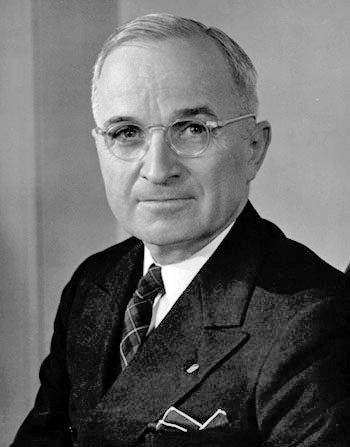
Harry S. Truman
See the contrarian stand of the mighty USA and even the relatively
nascent Australian nation. President Truman could not tolerate the
humiliation of Japan’s attack on Pearl Harbour and dropped two atom
bombs on that country despite having won the World War II with it. The
USA did not tolerate 9/11 and, smuggling its secret Seals into Pakistan,
shot Osama Bin Laden in the head, loaded his wrapped corpse with tons
of weight and unloaded him to the bottom of the seas. End of story.
As for Australia, more than one of its Prime Ministers have asked
Muslims to leave their country if they cannot accept the Australian way
of life. But even if a minuscule section of our people does that, hell
will surely break out. Why? Because we must “tolerate”.
Time seems to have come to accept that, on the external front, our
nation’s “tolerance”, touted as the “core value of our civilization”, is
only cowardice. On the internal front, “intolerance” exists because it
is compounded by the sheer lethargy in our police and judicial systems
wherein a violation of law will be punished, if at all, after years of
meandering through layers of investigation and more layers of justice
delivery. It is on those layers that sermons are essential from Raisina
Hill, from Birbhum and elsewhere.
Finally, let’s turn to the Rashjtrapatiji himself,
He was the one who was indicted by the Commission of Inquiry set up
by the Morarji Desai government of 1977 under J.C. Shah, a retired chief
justice of India.

Below are excerpts on page 82 of the Interim Report, Part I, of the Shah Commission given on March 11, 1978:
Paragraph7.230: “
It is thus clear on the basis of evidence that
has been brought on record that Mr PRANAB KUMAR MUKHERJEE the then
Minister of Revenue and Banking has misused his position and abused his
authority in ordering the detention of Smt Gayatri Devi and Colonel
Bhavani Singh on wholly insufficient grounds. IT IS A CLEAR CASE OF
SUBVERSION OF LAWFUL PROCESSES AND OF ADMINISTRATIVE PROCEDURES”.
And, on page 57 of the above Interim Report appears the following:
Paragraph 7.49: “
Although Shri Pranab Mukherjee assisted the
Commission at the preliminary stage of the fact finding inquiry, he did
not file any Statement in this case as was required to be done under
Rule 5 (2)(a) of the Commission of Inquiry (Central) Rules 1972. He had
responded to the Summons u/s 8B of the Commissions of Inquiry Act, 1952.
But he refused to take oath and tender evidence. However, from the
facts on record and the evidence analysed above, it appears that the
normal established procedures in regard to the appointment of the
Chairman of the State Bank of India (SBI) was not followed in this case
and further it was not in accordance with the provisions of the State
Bank of India Act, 1955, which made consultation with the Reserve Bank
of India a condition precedent to the appointment of the Chairman of the
SBI by the Central Government.
“
The Commission is of the view that considerations other than
strictly professional and totally extraneous have unfortunately been
allowed to operate in arriving at the decision to appoint Shri
Varadachari as Chairman of the SBI. Shri Pranab Mukherjee has violated
established Administrative Conventions and Procedures and misused his
position in the appointment of Shri Varadachari.”
Now, if not the young generation of post Emergency (1975) period, at
least some of the older ones know of the above findings. It is true that
after Indira Gandhi came to power once again in 1980, those findings
were dubbed as “beyond the jurisdiction of the Commission” and all
copies of its Report were sought to be destroyed, so as to be totally
removed from our country’s history records. That effort failed because
at least one copy survived and a Member of Parliament, Era Sezhiyan,
republished with the heading shown in the picture alongside.
We know that Ram Jethmalani, the doyen of lawyers, even chose the
above contents of the Shah Commission Report to launch a campaign
against the Rashtrapatiji’s election to the Raisina Hill in 2012. But no
one protested publicly; no one
gheraoed the Rashtrapati;
nobody went before TV cameras with a black gag on the mouth, and no
media dared to hype it. Why? Because, Rashtrapatiji, we are, in fact, a
tolerant nation. We
are tolerant despite what the media, the
sahityakars, the political Opposition, the Supreme Court and you yourself might say in your sermons.
But please remember just one thought. While your Emergency was the
limit of “intolerance’, “tolerance” too must have a limit, especially if
it is always one-sided.
Arvind Lavakere has been a
freelance writer since 1957. He has written and spoken on sports on
radio and TV. He currently writes on political issues regularly. His
writings include a book on Article 370 of the Indian Constitution.


