Tuesday, November 15, 2016

Demonetization-The Major Reset In India

Demonetization-The Major Reset In India
Creation of black money will be quite difficult all over again in India as compared to 1978 when India did the demonetization of higher currency.
Through notification on November 8th, 2016, all currency notes of the denomination of INR 500 (approx USD7) and INR 1,000 (approx USD15) have been demonetized by Central Government of India. Those currency notes ceased to be considered as legal tender after midnight on the day of the announcement. The move has been aimed to curb black money (illegal money) and fake currency notes in circulation in country’s monetary system rampant across India. This decision is one of the boldest and strongest steps in Indian’s post-independence history towards eradicating illegal money.

Will India move to non-cash society? Many are thinking this as only currency demonetization but it is not. If India needs to move to a cashless society, efforts are to be made to make people understand its benefits. Demonetization needs to be followed by political reforms so that the money based political donations to the parties, funding of elections are controlled. Business reformists have to step up usage of electronic and banking channels for all transactions. Other follow through measures like educational reforms, healthcare role out, a creation of transparent, accountable and responsive governance focused on sustainable development are implemented.

This bold decision has not come sudden. In fact, several measures were taken already by the Government to move the economy forward such as connecting large population with the banking system through opening of “Zero Balance Account”, making compulsory payment of subsidy of cooking gas through bank account, opening up many Industry sectors for 100% FDI including e-Commerce etc. One may expect many more policy changes in the days ahead. So cleaning up black money was a necessity. The impact will be greater in areas which use black money such as, Real Estate, Gold and Diamond, etc. Prices of real estate may fall considerably, Sales of Gold may see a downward trend. Otherwise, not much should happen, and life should be back to normal within a few weeks.

Many of those leaders, government officers, businessmen, lawyers, doctors, media, and other professionals, who have to now publicly support the decision and call it as brave, are worrying about their big unaccounted cash. It is those people who are making noise through citing problems and sufferings of people and blaming the government. Whereas common people are welcoming the decision expressing readiness to bear initial difficulties. Luckily people from the earlier government are not saying, Oh! This was planned by us, but Modi is now following our decision.
The new bank accounts that have been opened for and by the common public can be a very strong basis for bringing the cash-based economic activities to about 20% from the current level of 80%. The black money, anti-terror steps and parallel economy will be reduced for the time being, but these must be stopped permanently by all other means. Black money may come back by finding loopholes, but it will take some time.

The real problem in India is a lack of political will. The attitude is “Let it run as is”. If you try to fix one thing (however good your intention may be), then other unrelated things will fall apart. Since the decision of demonetization of currency notes was announced several rumours started spreading viz “Salt is not available”, “Petrol Pumps are not accepting old currency”, “Food Shops, Malls are being looted”. They create panic among people. No doubt shortage of currency is causing difficulties. The storage capacity of ATM is another problem why people are waiting for long hours and finding money got finished. Considering our large population and high cash based economy, our ATMs should have been designed with higher storage capacity for large circulation needs. Availability of lower denomination currency should have been anticipated and arrangement at the point of exchange. The routine economic activity at smaller levels would not have suffered so much.

 Since the preparations for demonetization were going on for the last several months, it would have been better if the government had envisaged the problems of the common men and released a large quantity of smaller denominations well before announcing this scheme. Large scale problems pose even higher risks. Reduced traffic on the roads and a very low number of the shoppers in the markets is proof that it is causing serious losses and problems to so many people.

In spite all these problems being faced by the common citizen, the long-term outcome is going to be positive and better. Let us not create panic by precipitating smaller issues. Creation of black money will be quite difficult all over again in India as compared to 1978 when India did the demonetization of higher currency which were much lesser in circulation and were not in possession of common people.


mroy@gmail.on'
Mousumi Roy is a columnist and based in Muscat.

Thursday, October 27, 2016

Western Recipe to dismantle India and Hinduism

Atrocity Literature: A Western Recipe to dismantle India and Hinduism
It is high time that we take note of such propaganda wars being inflicted on India and Hinduism using Atrocity Literatures.
Mayo’s Mother India was perhaps one of the earliest attempts at creating Atrocity literature against India and Hinduism and this has continued to this day by various vested interests that are inimical to India and Hinduism.

What is Atrocity Literature?

Atrocity Literature” is a psychological warfare which the West has been using for centuries to subjugate, control, digest and ultimately destroy native cultures and civilizations.  This, when supported by media can have a devastating, long lasting and sometimes permanent effect on that target civilization/culture. It is particularly dangerous, because it makes the people of the civilization, which is being targeted; believe that those who are trying to destroy them are their saviours. The West has successfully used this against Native Americans, African Blacks, Bharath and many other places it colonized and invaded. Christian Missionaries/Church, NGO’s, Western/Indian Academic institutions, Private Western Foundations, Human/Animal Right groups, Media, and Western Governments – have all used Atrocity Literature to undermine India.
In “Breaking India”, Rajiv Malhotra describes Atrocity Literature as a “technical term referring to literature generated by Western interests with the explicit goal to show the target non-Western culture is committing atrocities on its own people, and hence in need of Western intervention”[3].  The ultimate aim of Atrocity Literature that is being produced against Bharath is to demean our culture and religion, specifically Hinduism, and ultimately destroy it. This strategy is based on a simple fact that every society, civilization, system, religion, country, community or even artificially formed communities like labour unions will have members, who do criminal acts/atrocities. This is also true with social institutions like marriage, joint family, etc.
Let me explain this using a small example. Let’s say there is a city with a population of one crore and 500 people got murdered there in the last 5 years. Obviously in a city of 1 crore there will be people from all walks of life. Also every group will have both victims and criminals. If the pre-decided narrative is to demonize tall men against short men in that city, Atrocity Literature will be created supporting this. Obviously there will be a few murders where tall men kill short. Such news gets to the media headlines immediately and will be presented as tall oppressing short. Judiciary might decide later on, that the murder/s have nothing to do with the height, but this gets almost no media coverage. The narrative of tall oppressing short gets established in the minds of the people over a period of time because of media propaganda.
So, Atrocity Literature can be used to demonize any particular community as being oppressive and discriminative towards another community, especially when such assertions have no real basis. It is difficult to understand the biases unless one goes deeper into the statistics. The worst part is, those against whom Atrocity Literature is created, tall people in the above example, themselves start believing in this narrative and a few of them will even approach those, who are trying to malign them, for help. The tall community, thus, demonized, will be finally dismantled on the pretext of saving the short. And the short people, who are portrayed as the victims, may actually be the real aggressors, who produced the Atrocity Literature to undermine the tall people. Now, replace the tall people in the example with Hinduism and short people with various Abrahamic and secular ideologies, and you will get a full picture about what is happening in Bharath.
So, a narrative is decided first and the news, which fits into this pre-decided narrative gets the coverage in the media. Add to this, those news items, which have been distorted and twisted to fit it into the pre-decided narrative

Is India the Rape Capital of the world?

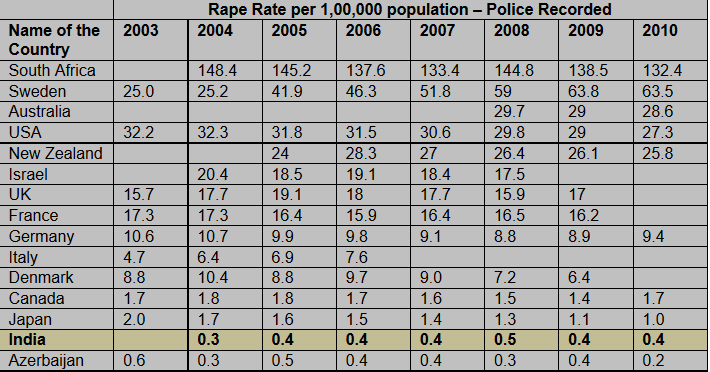
Ever since Nirbhaya rape incident, there is continued coverage by both national and international media about rapes in Bharath. At a point of time, Bharath was called the rape capital of the world. A German university even rejected admission to an Indian male, citing the security of female students in the university as a reason[4]. While even a single such incident is shameful to the entire nation, we also should not forget about the reality. Here are the statistics for rape rate from 2003 – 2010 as per United Nations Office on Drugs and Crime[5].
chart
German professor can’t be blamed. The problem is Atrocity Literature and its propagation through media, which created an image that “Indian men are rapists”, though we are lot better than several so called developed countries. This is despite our inferior judiciary and police, at least in quantity, if not quality. The rape incidents fit into the pre-decided narrative of the left-liberals and feminists that – India, especially Hindu society, is a patriarchal society and women are being oppressed.
chart
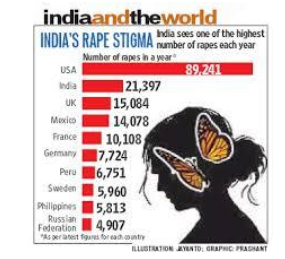
This is an example of how data can be twisted to suit the pre-decided agenda. We are shown India as having second highest number of rapes per year, but without a reference to total population of the countries. The total population of all the other countries put together is less than 100 crores, and so less than India’s. So, the rape cases in the rest of the countries are nearly 8 times as many as India.
“Access and Equality in Higher Education: Aspects of Gender, Caste, Ethnicity, Religion, Occupation and Economic groups in Rural and Urban Areas during Pre and Post Reform Periods[6]”, a research paper, is another typical example of Atrocity Literature, which tries to portray that there is discrimination in higher education in Bharat. This is produced by Indian Institute of Dalit Studies, a NGO started with the funding of Ford Foundation[7]. Around 90% of their donations for the past 3 years are from Western institutions and missionaries/Church[8]. One of the scholars presenting the paper, Nidhi Sadana Sabharwal[9] and the current Chairman are from JNU[10]. One of the trustees Sri Martin Macwan10 is a Jesuit7 (Society of Jesus)[11] working for Dalit Christians[12].
Narratives being created around indigenous practices like Jallikattu, Kerala Temple elephants, Holi, Deepavali, Dahi Handi, Ganesh Chaturthi, Sabarimala, etc. all fall under the category of Atrocity Literature.
The modus operandi is same in each case. Choose an indigenous festival or practice. Then prepare documents showing that there are atrocities and then demand for a ban. Take the example of Jallikattu, where you have a large number of bulls participating in the event. It is obvious that there may be a few incidents of mistreatment of bulls. But, this cannot be a justification for a blanket ban on the entire event. It is like asking for a ban on travelling because of accidents. The solution is reform and tight monitoring and not ban. The real objective behind all the outrage is to distance the Hindus from their culture and tradition, so that they can be easily converted[13].

Same news can fit into different narratives

Several times a pre-decided narrative decides how a particular news is presented. Let us consider one recent incident.
Actual News: A person, who happens to be the husband of a patient, hits a nurse in a hospital[14].
News with all the tags attached: Paramjit Singh, a leader of Akali Dal Punjab, hits a nurse, who is pregnant for not being given preferential treatment in a private hospital
Probable Narratives-
  1. Akali Dal suppressing females
  2. Punjab is unsafe for women
  3. Nurses under attack
  4. Another pregnant women attacked in India/Punjab
  5. Staff of a private nursing home attacked again
More such narratives can be constructed based on caste, religion, skin colour, region where the incident happened, etc.
It is high time that we take note of such propaganda wars being inflicted on India and Hinduism using Atrocity Literatures and take proper measures to counter it.

by


Sunday, October 16, 2016

India before the British Conquest


Many Indians in the past and even in the present justify the country’s subjugation by the British as a blessing in disguise, stating that Colonialism was the best thing that could have happened to India.

India is a living civilization. No other nation has a continuance of philosophies, rituals, cultures and traditions in the manner in which India has it. Even after thousands of years, of which there were centuries of wars, invasions, enslavement, mass killings, poverty, starvation and relentless attacks by foreign ideologies, what we have achieved as a nation is remarkable.

But, any country which has gone through alien rule for centuries will struggle to find a deserving place for itself among the community of nations. Any foreign domination for so long would scar the minds of the victims so deeply that it almost always translates into an “inferiority complex” or a kind of “identity crisis” among the ruled; compelling them to somehow live up to the rulers’ expectations and to mimic them.India has been no exception to this phenomenon. Our own people during the British Raj (and even today) justified India’s subjugation by foreigners as a blessing in disguise, by declaring with great pompousness that Colonialism was the best thing that could have happened to India. They argued that the British (just like their previous counterparts) were liberators and not subjugators- liberators from Brahminism, caste hierarchy, superstitions, backwardness and many more evils.

This feeling has not lost its popularity even today and this is what we know about our history in the popular culture. We as a nation have developed a fondness in eulogizing our conquerors and ignoring or even blatantly dis-respecting our own people and their achievements. This in fact has translated into our actions in many fields and one such important field is the writing of the Indian history.
For instance, it is vastly believed among our ‘intellectuals’ and ‘mainstream historians’ that the arrival of Islam into mainland India was mainly due to the change of opinion among the masses, who favored the ‘equality’ in Islam for the ‘oppression’ of the Hindu caste system. They vehemently argue that India was invaded by a “few thousand” men, who were able to succeed, because Hindus lacked unity among themselves, and the lower-castes were unwilling to defend their country and their upper-caste kings. But, a thorough examination of the primary sources reveals that there is no truth in these assertions.

First, the invading armies were not comprised of only a “few thousand men”. When Mamud of Ghazni attacked the Somnath temple in 1000 CE, for example, he employed a fleet of 30,000 camels only to carry water supplies, informs KS Lal, a reputed historian of the medeival period. When Mahmod Ghori attacked North India in 1192 CE, he had 120,000 men in cavalry alone! Later Islamic rulers had stronger armies: Alauddin Khilji had 475,000 horsemen and Mohammad Tughlaq had 900,000 of them under his command. [Koenraad Elst]. These Islamic invaders, however, succeeded after facing a strong and successful resistance set up by the Indian rulers over a vast period of 5 centuries.

Second, the social structure aspect of India was not that dim either. Many Islamic writers of that time like Alberuni, Abul Fazl, Jahangir, etc. have not once mentioned the supposed tyranny of the Hindu caste system as a reason for gaining converts to Islam. Moreover, not a single instance of the so called lower classes, making common cause with the invaders can be noted. On the contrary, many examples of lower castes fighting side by side with the upper caste kings are available. Many examples of Shudra dynasties protecting the Brahmins from the invaders can also be seen [ibid]. However, these aspects of unity and harmony within Hindu society are almost always ignored and the main reason for the Islamic invasions is always projected to be social factors, rather than the religious and the military factors.

These types of “myths” are numerous in number and still vastly held as ultimate truths. All these only confirm a need for us to view our history through more neutral means than to follow what our conquerors wanted us to believe. This article is a small attempt in that regard.

Now, considering India’s written history (“secular history”), we find evidence of Indian lifestyle from the Greek records. Many Greek writers have travelled to India and have recorded their experiences of this land. One such Greek writer was Megasthenes (320 BC-290 BC), who was the Greek ambassador to the Mauryan Empire, during the period of Chandragupta Maurya. In his work “Indica/Indika”, Megasthenes explains what he had seen first-hand in India during his stay in the country [Though the original work is not available, a small portion of the book is re-constructed on the basis of direct quotes of his work by other ancient Greek writers].

Then, we have, Hiuen Tsang (602-664 CCE), who in his SI-YU-KI (The history of the western world), explains in detail his experiences from his long travels (almost 15 years) through many places in India. Later, Fra Paolino Da Bartolomeo (1748-1806), an Austrian-born Carmelite missionary and orientalist, who was in India from 1776-1789,narrates his experiences of India in his “Voyages to East Indies” (published in England in 1880). All these accounts are first-hand and can be considered neutral. Though non-exhaustive, these accounts will surely give us profound insights and a bird’s eye view into the ancient and medieval Indian societies. Based on these accounts, the following points can be considered.

People and society

In ancient India, when Megasthenes was writing his Indica, people were generally healthy and fit and pursued various arts and skills. This is often attributed to the abundance of the means of sustenance, pure air and the availability of fresh and the finest drinking water. The land was very fertile bearing various kinds of crops, plants and trees. Various metals, including copper, iron, gold and silver, were extensively mined to make ornaments, jewellery, weapons, shields and other articles of use.

There were cities, well-built houses, different types of clothes and fashion, etc. Famines and its disastrous effects were unheard of due to proper preparations to face such situations and also because of the immunity enjoyed by the farmers and their crops from harassments, even during the times of bloody raging wars (This is in conformity with the rules laid out in the Yuddha Sashtra about not hurting common men and their property during the times of war).

The social structure of the time constituted seven castes, but without any gradation or oppression (at least in the accounts of Megasthenes). Further, the then Indian society had no slaves and the freedom of individuals was respected. It was believed that all Indians, though of different cultures and traditions, were indigenous to India, and India was never invaded by any other people (This point also goes to show how the idea of indigenousness of all Indians is not a new construct of the nationalists, but had prevailed in ancient India too).

All these indicate to a well-established and well-functioning society, which must have flourished over a long period of time to reach this state, during Megasthenes’ times.
However, by the time of Hiuen Tsang, who wrote his account in the 7th century, the social structure appears to have become slightly rigid, with strict divisions between various castes in styles and behaviours. But, despite this rigidness, no instance of oppression, harassment or conflict among the different castes can be found.

There were well planned cities with proper compounds, watch towers and roads. The houses were built of wood, which were covered with coatings of lime and mortar (a sort of binding paste comparable to modern day cement) and sometimes covered with tiles. They also had balconies and belvederes and were decorated with cow-dung (for purity) and with various patterns of flowers. A special type of multi-storeyed buildings called the “sangharamas” (may be a kind of temple or a place for monks) were built with extra-ordinary skills using intricate designs and decorations like paints and suitable ornaments.

Various materials like cotton, silk, hemp, wool etc. were used in clothing and fashion. People mostly wore fresh-white garments, whose description resembles the style of Dhoti for men. Women, on the other hand, covered their shoulders with a robe falling down to the ground. Usually, people wore a crown /cap on their heads, flower wreaths and other jewelled ornaments. Some people also wore sandals, decorated their hairs in different styles and ornamented their noses. However, the royalty and the ministers used various ornaments like necklace, bracelets, head gears decorated with gems and various styles of garments.

The above features strongly suggest the presence of a flourishing textile and ornament industry. It also gives an impression that the people were well dressed and well-mannered. Moreover, it can be seen that the people were very particular in their personal hygiene. Various practices were followed to maintain cleanliness like washing the hands before partaking the food and cleaning the mouth and teeth after having food, not eating the stale food, multiple bathing in a day, rubbing & polishing utensils (made of gold, silver and iron) used for cooking and eating purposes, proper cleaning after finishing calls of nature, and using perfumes of sandalwood and turmeric.

These were indeed very progressive practices, when compared to hygiene conditions in other areas of the world, especially the situation in Europe of those times. In the early periods of the church, bodily cleanliness was perceived as a symbol of luxury, materialism, and paganism. It is often said that Europe during the middle ages, went a thousand years without a bath, which obviously is an exaggeration, but nevertheless depicts the prevalent disregard for hygiene.

Another important aspect of the society was the functioning of the army. The art of warfare was usually taught to children (in their early age itself) by their parents and only the strongest and bravest were inducted into the military service. There were four divisions of the army viz. infantry, cavalry, chariots and elephants. The weapons used included among other things: sharp spurs (fixed to the tusks of elephants), armours for war elephants and horses, long spears, big shields, spears, bows and arrows, sabres, battle-axes, lances, halberds, long javelins and various kinds of slings, etc. The extensive use of various kinds of weapons not only points towards the presence of a well-trained professional army, but also towards the presence of thriving defence industry, which engaged in production of various chariots, metal weapons, shields and armours.

Similarly, extensive accounts about the flora and fauna; various drinks, dishes and refreshments used by the people; law and order mechanism; judicial, financial, and administrative institutions; medical practice; arts and crafts; trade and commerce; tax structure and wages for labour, and record keeping, can be found, which goes to show how the society was very large, diverse, and well-functioning, in the 7th century.

However, by the time of Bartolomeo (who visited in the 18th century), it appears that the peoples’ general welfare had vastly deteriorated and very rigid caste distinctions had cropped up, largely due to being exposed to repeated invasions and conquests by the Islamic rulers. Confirming this that the Indian society had seen a great decline, since the native kings were expelled by the foreign conquerors, Bartolomeo writes: “…Before that period, the different kingdoms were in a flourishing condition; the laws were respected, and justice and civil order prevailed: but, unfortunately, at present everything in many of the provinces must give way to absolute authority and despotic sway.” [Bartolomeo]

Education

Though, no description of the education system can be found in the available parts of Indica, both Tsang and Bartolomeo attest to the presence of a well-established education system in pre-British India. Moreover, Bartolomeo, while describing the way Indian kids learn reading and writing (writing the alphabets by a finger or a stick, on sand or paper, while simultaneously pronouncing its sound), comments that the practice was used, since the times of Megasthenes (It should also be noted that according to Lieutenant General Alexander Walker, the process was borrowed from India by the Europeans). Tsang also informs us that the children before age 7 were taught the book of twelve chapters (siddhavastu). Later they were taught five vidyas viz.

Shabdavidya- Deals with language and grammar
Silpasthanavidya- Deals with arts, mechanics, calendars and also explains the principles of various components of the nature such as fire, water, darkness, coldness, etc.
Chikitsavidya- Deals with medical practice and treatment.
Hetuvidya- Deals with logic and causality.

Adhyatmavidya- Deals with theology and spirituality.

Tsang, additionally, states that the Brahmanas studied the Vedas and Shastras and thus, indicating that the previously mentioned five vidyas were perhaps taught to everybody, irrespective of their caste or social standing. Otherwise, the author would have stated that the Brahmanas were the only class allowed to learn anything and the need for a distinct and specific mention was unnecessary.

Further, Bartolomeo tells us that the education system had suffered (like other aspects of the society) much after foreign conquerors had expelled the native kings. Despite this, Bartolomeo tells us that reading, writing, grammar, accounts and oratory were taught. Additionally, the following subjects were also taught to the children: Poetry (Gavya); Fencing (Payatta); Botany and medicine (Vaydyassastra or Bheszagiashastra), Navigation (Naushastra), use of the spear on foot (Hastiludium), art of playing at ball (Pandacali), Chess (Ciudarangam), Tennis (Coladi), Logic (Tarkashastra), Astrology (Giodisha), Law (Svadhyaya), Silence (Mauna). [Interestingly, it is mentioned in the notes given to the work of Bartolomeo by Johann Reinhold Forster (1729-98), a Scottish historian and naturalist that Pythagoras must have borrowed his philosophy in part from the Indian Philosophers in the account of stark similarities between the Indian art of silence and other rules like celibacy, which Pythagoras also asked his disciples to follow.]

Moreover, the Indian education was very cheap and affordable compared with the then system in Europe and also gave a fair opportunity to the students in selecting what subject they wanted to pursue rather than treating all of them as homogeneous entities destined to achieve a single goal.
Furthermore, many British authorities had surveyed the situation of the education sector in various parts of India during the early 19th century. Accordingly:

In Madras Presidency, there were 12,498 schools for a population  of 12.85 million, teaching 188,650 students. There was 1 school for every 1,000 people and taking into account homeschooling, which was also widely prevalent, the ratio would have been much lower [Sir Thomas Munro, as quoted by Dharampal].

In Bengal and Bihar, most village had a school before 1800 CE. During the surveying period, 100,000 villages out of 150,748 had schools. Each of the 18 districts of Bengal had 100 institutes of higher education teaching almost 10,800 scholars [William Adam].
In Natoore Thana of Rajashahy district, there were 27 elementary schools teaching 262 students and 38 higher education institutes teaching 397 students. Out of 30,028 families, children of 1,588 families received home tutions. [ibid]
In 20 Thanas out of 37 surveyed in Murshidabad, there were 1,098 Bengali, 375 Hindi, 353 Sanskrit, 694 Persian, 31 Arabic, 8 English, 6 girls only and 1 infants only schools. [ibid]

Extensive research was also conducted in Punjab and Bombay presidency and the situations there were similar. All subjects stated before were taught and some institutes also taught arts and music. An important point of consideration is that both teachers and students were drawn from all castes. In some places (some of which were considered as places of hardcore “Brahamanism”), the number of teachers and students coming from the lower castes greatly outnumbered those from the upper castes.
Though, widespread illiteracy was recorded, and though, it partly reflected ground reality, the major factor behind such a recording appears to be the fact that a large number of young boys and most young girls were tutored at home. What is important to note is that Indians have a long tradition of imparting education to young children. In fact, teaching children to read and write constitutes one of the 16 mandatory religious ceremonies in a Hindu household.

A rather vivid depiction of India as found by the British when they arrived here given by J T Sunderland nicely sums up the condition of India before the British:
“…….This wealth was created by the Hindu’s vast and varied industries. Nearly, every kind of manufacture or product known to the civilized world-nearly every kind of creation of man’s brain and hand, existing anywhere, and prized either for its utility or beauty-had long, long been produced in India. India was a far greater industrial and manufacturing nation than any in Europe or than any other in Asia. Her textile goods-the fine products of her looms, in cotton, wool, linen and silk-were famous over the civilized world; so were her exquisite jewellery and her precious stones cut in every lovely form; so were her pottery, porcelains, ceramics of every kind, quality, colour  and beautiful shape; so were her fine works in metal-iron, steel, silver and gold. She had great architecture-equal in beauty to any in the world. She had great engineering works. She had great merchants, great businessmen, great bankers and financiers. Not only was she the greatest ship building nation, but she had great commerce and trade by land and sea which extended to all known civilized countries. Such was the India which the British found when they came.” [as quoted in Will Durrant]

Bibliography


  • Koenraad Elst, Decolonizing the Hindu Mind – Ideological Development of Hindu Revivalism. Delhi: Rupa and co, 2001

 
Philosopher and Economist, writing on Philosophy, History and current affairs.

Wednesday, October 12, 2016

भगवान राम को गुंडा, देवी दुर्गा को वेश्या कहने वाले ज्ञानी लोगों से बचिए


बुद्धिजीवियों के अधकचरे ज्ञान का प्रदर्शन शुरू हो चुका है जहाँ राम को ‘असली गुंडा’ और रावण को ‘मर्यादा पुरुषोत्तम’ बताया जाएगा।

ये कहा जाएगा कि कैसे रावण ने सीता को छुआ भी नहीं ब्ला-ब्ला-ब्ला जैसे कि उनका हरण उसने पार्क में साथ बैठकर दही-जलेबी खाने के लिए किया था। बाल्मीकि रामायण के उत्तरकाण्ड में रावण के ‘कामपिपासा’ का भी ज़िक्र है जब उसने एक स्त्री का (आज के शब्दों में) बलात्कार किया था, ये भी है कि अपनी ही बहन को विधवा बनाया था।

लेकिन ये सब क्यों पढ़ेगा हमारा ‘वानाबी बुद्धिजीवी’। उसको तो बस एक बात चाहिए जिससे एक, जिसने अपना हर काम मर्यादा से किया, वो बुरा दिखे, और एक, जिसने हर काम अपने हठ, दुराचार और महात्वाकांक्षा से किया वो अच्छा दिखे।

मतलब रावण का ना छूना सीता के ना कहने तक सीमित था? या फिर वही रामायण, या मानस, जो बुद्धिजीवी पढ़ नहीं पाते (और फ़ेसबुक पर ज्ञान के अथाह सागर वाले जेपेग इमेज से अपनी बात का आधार पाते हैं) वो ये कहता है कि सीता का तेज ऐसा था कि रावण उसको छू ही नहीं पाता। अब कहोगे कि ये तेज-वेज क्या होता है? वो तुम्हारे वश का नहीं है समझना।

पहले ये डिसाइड कर लो कि रामायण को इतिहास मानते हो या मायथोलॉजी। इतिहास मानते हो तो जो लिखा है उसको सही मानो। मायथोलॉजी मानते हो तो फिर इस पर वाद-विवाद कैसा। जो हुआ ही नहीं उसका सबूत क्यों माँगते हो? फिर तो जो है उसको कहानी की तरह पढ़ो और अपनी सीमित सोच के दायरे में रहकर समझो।
एक ग्रंथ में पात्रों की रचना होती है जिसे देखकर आने वाली पीढ़ी कुछ सीखे। उसमें नाम चाहे राम हो या रावण, सबकी अपनी विशेषता होती है। कोई संपूर्ण अच्छा या पूरी तरह बुरा नहीं होता। इसीलिए राम अपनी पत्नी को अग्नि परीक्षा के लिए पूछते हैं क्योंकि राम एक राजा थे और प्रजा के प्रश्नों के लिए उत्तरदायी थे। राम के राजधर्म ने उन्हें सीता से अग्निपरीक्षा लिवाई। तुम फ़ेमिनिस्ट बनोगे तो राम गलत दिखेंगे, तुम राजधर्म की दृष्टि से देखोगे तो तुम्हें पता चलेगा कि राम को सीता पर कभी संदेह नहीं था लेकिन प्रजा को भी संदेह ना हो तो राम ने एक राजा के तौर पर अग्निपरीक्षा की व्यवस्था की। उसी फ़ेमिनिस्ट को ये नहीं दिखता कि एक नारी के सम्मान के लिए राम ने रावण से युद्ध किया।

रावण प्रकांड पंडित था पर उसका ज्ञान किसी की पत्नी के हरण में गया। राम ने हर यत्न किया कि युद्ध टले लेकिन रावण अपने अहम और सामर्थ्य के गुमान में युद्धातुर था और फिर वीरगति को प्राप्त हुआ।
पहले अपने ज्ञानचक्षु, अगर हैं तो, खोलो। पहले समझो कि क्या लिखा है और क्यों लिखा है। रावण को बाल्मीकि या तुलसीदास ने अचानक से बुरा नहीं बना दिया। नाम कुछ भी होता, उसके कर्मों से वो बुरा बना। आउट ऑफ़ कॉन्टैक्स्ट लिखने की कला अधकचरे और वानाबी इंटेलेक्चुअल्स की एक अदा है। इससे पता चलता है कि उनकी स्वयं की इच्छा क्या है। हलाँकि सवर्ण और दलित वाले संवाद में वो ये भूल जाते हैं कहना कि रावण ब्राह्मण था क्योंकि वहाँ इनका परपस सॉल्व नहीं होता।

ऐसे टुच्चे, अधकचरे और वानाबी इंटेलेक्चुअल्स से बच कर रहिए। थोड़ा इन ग्रंथों को पढ़िए, इन्हें समझिए कि कहाँ क्या बोला गया है। इन चिरकुटों से भारतीय समाज को बचाइए जो ‘ऑल्टरनेटिव रीडिंग’ के नाम पर देवी दुर्गा को ‘वेश्या’ तथा ‘महिषासुर’ को प्रतापी राजा बताते फिरते हैं। जब ऑल्टरनेटिव राइटिंग ही नहीं है, तो फिर रीडिंग कहाँ से हो रही है? किसी पुराण में तो ये होता कि दुर्गा या राम ने वो किया जो कम्युनिस्ट ‘विचारक’ फैला रहे हैं। नहीं है तो इसका साफ़ मतलब है कि आपका कोई अजेंडा है घृणा फैलाने का।

इसका मतलब है कि आप अपनी व्याख्या, आज के संदर्भ में, अपने ज्ञान के आधार पर कर रहे हैं और उसका आकलन हजारों साल पहले लिखे पुराणों और ग्रंथों से कर रहे हैं जब स्थिति अलग थी, जिसका इतिहास आप मानने को तैयार नहीं होते, और आपकी तरह के आधी बुद्धि वाले थोड़े कम थे।

ऐसे बुद्धिजीवियों को जब जब मौका मिले नंगा करते रहिए। इनका उद्देश्य ना तो फेमिनिज़्म है, ना ही बेहतर समाज की स्थापना है, ना ही दलितों को उनका हक़ दिलाना है। ये दुर्गा के शस्त्र उठाने को फ़ीमेल एम्पॉवरमेंट की तरह नहीं देखेंगे, वहाँ ये अचानक से वेश्या हो जाती है और एक स्त्री को वेश्या कहे जाने पर भी फेमिनिस्ट चुप हो जाता है क्योंकि ऑल्टरनेटिव रीडिंग देने वाला ज्ञानी व्यक्ति उसका साथी है।

ये मानकर चलते हैं कि हमें बुरी बात ही बतानी है निकाल कर वो भी अपने हिसाब से। इनका उद्देश्य सारे हिन्दू प्रतीकों की हत्या है क्योंकि हिन्दुओं ने भी रामायण की जगह फ़ेसबुक के जेपेग इमेज से राम की कहानी पढ़नी शुरू कर दी है। अपने समाज को, अपने धर्म को जानिए और ये ऑल्टरनेटिव रीडिंग वाली चोरों के गिरोह से बचिए चाहे आप किसी भी धर्म के हों।


Sabahr from Blog of Mr Ajeet Bharti!!!!!!!!!!!!

Sunday, October 9, 2016

Culture war against Hindus

The foremost source of unrelenting and egregious slander against Hindus is India’s film industry, led by Bollywood. Pakistani marauders were halted at the border in 1948 and repudiated every time subsequently, but its surrogates managed to seize control of India’s film industry. The economics of film making, forbidding bona fide investment until recently, allowed the Muslim underworld and its associates to infiltrate the industry by funding it. They were able to dictate the agenda of the film industry, insinuating a thoroughly anti national ideology and institute a standing critique of all things Hindus as well as propagate blatant and slanderous lies. Producers and directors became their playthings and selected artistes found a privileged entry in exchange of reciprocal favours that included every type of venal personal degradation.

Villains of every description, from torturers, rapists, murderers and espousers of every retrograde social custom, somehow sport a tilak and worship some incomprehensibly weird Hindu deity. By contrast, the gentle Muslim neighbour or preacher or Christian priest epitomises generosity and brotherhood. Both unfailingly reach out to look after the confused Hindu facing some personal crisis and resolving some tricky problem engendered by their own absurd religious prejudices. The abandoned Hindu mother, brutally trampled underfoot by her devout Hindu mother-in-law, always finds a teaching job in a Christian school, under the mellow guidance of a mother superior. In Kollywood, Bengali society is often depicted terrorising an educated and independent Hindu girl, in love with a Muslim boy from a humble background, also in keeping with the illusory egalitarian ethos peddled by Bengal’s neutered cultural elite. There are exceptions of course, but they truly underline the contrary rule of demonization.

And ever-present are the caste ridden evil Brahmin, much the way Jews were portrayed by god fearing Christian Europe, before the Nazis resolved the problem in inimitable fashion through mass murder. In addition to the horrors of caste in Indian society, the timeless lament at the Hindu society’s mistreatment of women and a penchant for infanticide, standard fare of colonial conquerors, before they too addressed the problem through genocide and looting. Class oppression has been another favoured theme, tearfully underlined by privileged cine artistes, themselves living in stupendous luxury, the richest among them today worth in excess of US$ 750 million. Yet rarely, if ever, a whisper about the fate of women in India or indeed elsewhere under the medieval jackboot of the Shariah or the truculent determination of the faithful to extract the last pound of flesh, loudspeakers blaring the call to prayer before dawn and major thoroughfares routinely blocked during Friday prayer.

This unforgiving depiction of Hindus, their culture and history has been thoroughly imbibed by the Hindu society itself. The default of the Hindu psyche has been apology for who they are and instinctive defence of their critics as the wronged party in Indian society. The popular ideology of Bollywood has its faithful counterpart in books used in Indian schools and university curricula. They are apparently consciously designed to create self-doubt, if not subliminal self-loathing of their past, their cultural and spiritual identity. Indeed, these pedestrian texts reflexively question the very basis of Indian nationhood. Much of the work of post independent history is studiously silent on critical issues of India’s painful past, actively denunciatory of alternative perspectives and slanderous of their authors, however renowned and scholarly. Their own material is usually slyly dishonest and rarely impartial and all designed to supposedly promote communal harmony by telling blatant untruths. These morally bankrupt historians ignore the bitter travails of the entire millennia of unspeakable horrors, mass murder and slavery and point instead to the alleged evils of conquered Hindu society.

The bedrock of self-hatred, dispensed by India’s secular elites, found a powerful echo abroad that compounded the severity of the impact on Indian society. The Anglo-American and European contempt for India arose from deep-seated historical impulses and India’s reluctance to join the aggressive Western Cold War campaign against communism. The British had also held India’s Hindu elites responsible for the patriotic fervour that eventually led to their ejection from India. Its roots can be traced back to the late nineteenth century and British sponsorship of the Muslim League that culminated in the conspiratorial relationship with Mohammed Ali Jinnah almost fifty years later, to deliver the coup de grace of partition. Virtually all British social science and academic scholarship on India and, as its obverse, Pakistan, was intentionally complicit in the project to demonise India. Its potent influence can be found in their abiding hostility towards India and Hindus to this day, led by British universities, their media and its particular ubiquitous incarnation, spreading half-truths and vicious canards.

India’s refusal to join the US-led Cold War alliance played a crucial role in the West’s hostility towards India, though now waning in dramatic ways, as illustrated vividly in the recent days. In addition, Indians, unlike the Chinese, were viewed as enslaved people and unworthy of assimilation to the status of white or the honorary category accorded to some by South African apartheid. This undoubted racism informed the perceptions of the US policy makers and the British dominance of hostile scholarship on India also became the template that spread across the Atlantic. Virtually no practising Hindu is allowed to hold a major appointment in any US or British university in Hindu studies, with such positions invariably occupied by its most unsparing detractors, whether at Harvard, Chicago, Columbia or Oxbridge or London. The contrast with sympathetic and accommodating attitudes towards scholarship on Islam or China could not be more unambiguous. Thus, the absurdly traitorous Indian Leftist hostility toward their homeland and their own culture found a sympathetic intellectual terrain abroad. Both combined to institute an unholy and improbable alliance of supposed Indian anti-imperialists and its most brutal historic purveyors globally against India.
Disclaimer: The facts and opinions expressed within this article are the personal opinions of the author. IndiaFacts does not assume any responsibility or liability for the accuracy, completeness, suitability, or validity of any information in this article.

Thursday, September 29, 2016

Anti-Hindu orientation of the Indian National Congress


The Congress failed the Hindus of the nation on four fronts:[1] It was solely responsible for vivisection of the Hindu bhumi in 1947; [2] Congress beginning with Gandhi refused to acknowledge the political objectives of Islam and Christianity and therefore resolutely refused to see that both Abrahamic cults and their adherents had only one political objective for their religion –to Islamise and Christianise the Hindu nation; [3] the Indian National Congress from after the death of Lokmanya Tilak refused to respect Hindu religious sensitivities - as demonstrated by Gandhi when Bengal’s Hindus were burning in jihadi fire, by Nehru who refused to ban cow slaughter by law and overre-building the Somnath temple; and by all successive Congress governments over Ramjanmabhumi and Ram Setu; Congress refuses even now to respect Hindu sensibilities about the cow and from 1947 has been obdurate in its refusal to make laws protecting the cow and banning cow and cattle slaughter; [4] Congress from the days of Gandhi has subverted the idiom of political discourse on nation and nationhood.

Hindu nationalists hold the Congress and its preeminent leaders during the freedom struggle guilty of inflicting lasting damage to the Hindu nation with their twisted sense of nation which instead of protecting the native Hindu populace, in fact turned against them.

The Congress party’s anti-Hindu ideology is rooted in Gandhi’s whims which were passed off as Congress Creed. Gandhi’s obdurate refusal to see the writing on the wall even after the Muslim League proclaimed that it would settle for nothing less than Pakistan, and the impotence of other leaders in the Congress to marginalise Gandhi in the 1930s decade, caused the vivisection of the Hindu bhumi.

In order that there may be no manner of doubt in any quarter, the Council of the All-India Muslim League reiterates that the attainment of the goal of a complete, sovereign Pakistan still remains the unalterable objective of the Muslims in India, for the achievement of which they will, if necessary, employ every means in their power and consider no sacrifice or suffering too great. (Resolution of Muslim League Council, June 6, 1946, the Transfer of Power, 1942-47, Vol. VII, pp 836-8,CWMG, Vol. 91, Appendix V, page 439)

The Muslim League left no one in doubt about the end objective of the so-called freedom struggle. This was June 1946. “Complete,sovereign Pakistan” could come about only by tearing apart the land of the Hindus. And yet, instead of equipping the Hindus to protect their nation from the imminent threat of vivisection, Gandhi, in December 1946 speaks the language of what will soon evolve into virulent anti-Hindu Nehruvian secularism.

There were some who described the Congress as a Hindu organization. They only betrayed their ignorance of the political history of India. At one time the Hindu Mahasabha was in the hands of the Congress and so was the Muslim League and others. Congress was not a Hindu organization. It did not serve Hindu interests to the exclusion of the other communities. It was hinted that the Congress leaders had come to consult him with regard to the interests of Hindus. Had they done so they would have lowered the stature of the Indian National Congress in the eyes of the world. They had come to consult him as an expert on the Hindu-Muslim question, as to how best to serve the national cause in the present crisis. (Speech at a Prayer Meeting, Srirampur, December 28, 1946. CWMG, Vol. 93, page 207)

Hindu nationalists cannot be faulted for concluding thatrather than “lowering the stature of the Congress in the eyes of the world”, Gandhi,and by default other Congress leaders, chose to partition the Hindu bhumi.

What we had to do was to prevent the Congress from turning into a Hindu communal organization. Anyone who had made India his home should be protected by the Congress. Hindus should never think that Hindustan belonged exclusively to them. (Interview to Deobhankar, My Days with Gandhi, pp 102-4, CWMG Vol. 93, page 124)

And in April 1947, when vivisection of the Hindu bhumibecame a certainty, Gandhi, the self-proclaimed “expert on the Hindu-Muslimquestion” had more pious platitudes for Hindus:

Hindus should not harbour anger in their hearts against Muslims even if the latter wanted to destroy them. Even if the Muslims want to kill us all we should face death bravely. If they established their rule after killing Hindus we should be ushering in a new world by sacrificing our lives.None should fear death. Birth and death are inevitable for every human being.Why should we then rejoice or grieve? If we die with a smile we shall enter into a new life, we shall be ushering in a new India. (Prayer meeting, April 6, 1947, New Delhi, CWMG Vol. 94,page 249)

Because picking up arms to protect the Hindu nation against the explicit threat to create Pakistan in the name of Islam constituted a “ Hindu communal” response, which went against Gandhi’s Handbook for Hindu Ahimsa also known as Congress Creed, Gandhi had remedy for jihad too – Hindus must allow themselves to be killed to the last man, woman and child so that “we die with a smile” to usher a new Islamised India; or Hindus must commit suicide. Die with a smile or be killed said Gandhi, but do not pick up arms to defend yourself,your women or your nation.

Gandhiji advised the women in East Bengal to commit suicide by poison or some other means to avoid dishonour. Yesterday he told the women to suffocate themselves or to bite their tongues to end their lives. But two doctors, BC Roy of Calcutta and Sushila Nayyar had informed him that such means of suicide were impossible. The only way known to medicine for instant self-immolation was a strong dose of poison. If this was so, he, the speaker,would advise everyone running the risk of dishonour to take poison before submission to dishonour. He had, however, heard from those given to yogic practices that it was possible by some yogic practice to end life. He would try and inquire. His was not an idle idea. He meant all he said. (Speech at a Prayer Meeting, New Delhi, October 18, 1946,CWMG Vol. 92, page 355)

Sardar Patel had no use for Gandhi’s prescription to Hindus against jihad in Bengal; and Gandhi was swift to react by shooting off a missive to Sardar Patel. Gandhi used insulting language with deliberate intent to demean and diminish Patel’s tall stature and as signal to the British government and to ordinary Hindus that he remote-controlled the Interim Government. Sonia Gandhi is playing a similar role today in the UPA.

I have heard many complaints against you. If there is any exaggeration in ‘many’, it is unintended. Your speeches tend to be inflammatory and play to the gallery. You have lost sight of all distinction between violence and non-violence. You are teaching the people to meet violence with violence.You miss no opportunity to insult the Muslim League in season and out of season. If all this is true, it is very harmful. They say you talk about holding on to office. That also is disturbing, if true. (Letter to Vallabhbhai Patel, Srirampur, December 30, 1946, CWMG, Vol. 93, pp 211-12)

Sardar Patel, as Gandhi’s letter to him reveals, had exhorted Hindus to fight back and defend themselves and this displeased Gandhi.It is also obvious that such was the general helplessness of the other leaders in the Congress vis-à-vis Gandhi that Sardar Patel instead of standing up to Gandhi and standing by his words, felt compelled to offer a weak defence.

The complaints are false of course and some of them do not make sense. The charge that I want to stick to office is a pure concoction. I was opposed to Jawaharlal’s hurling idle threats of resigning from the Interim Government. They damage the prestige of the Congress and have a demoralising effect on the Services... It is my habit to tell people the bitterest truths...The remark about meeting the sword by the sword has been torn out of a long passage and presented out of context.(Foot-note to Gandhi’s Letter to Vallabhbhai Patel from Srirampur, CWMG Vol.93, page 211)

If Gandhi did not allow Hindus to pick up arms against jihad in 1946, the nation’s perverted political discourse did not grant Hindus of Gujarat the right to pick up arms against jihad in 2002. There have been innumerable Hindu-Muslim riots in post-independence India under several Congress governments but Narendra Modi alone is reviled because he ruled Gujarat at the time when Hindu reaction to jihad unbound itself from the shackles of Gandhi-Nehru imposed impotence.

The Congress did not protect Hindus and the Hindu nation in 1946-47; Nehruvian secularism has failed to protect Hindus and the Hindu nation from jihad in J&K, in Kerala, in West Bengal, in Gujarat, from Pakistan,from the Generic Church and its geopolitics, and from the unfettered right given to the Church for religious conversion.

If Gandhi’s notion, that Hindu women when facing jihad,should bite their tongue to kill themselves was startling, just as startling were Gandhi’s views on Go samrakshana.

The cow was once a sacred religious symbol for Hindus; and that is why cow protection movements during Muslim rule and later colonial rule, were led by Hindu sadhus and sanyasis and powered by Hindus with dharmic sense of responsibility to protect her. The cow is upalakshana or generic for all animals. Go samrakshana is therefore an abiding consciousness of this dharma because the cow’s sacredness protects all animals from abuse.

Protecting the cow was ahimsa in practice if ahimsa is described as voluntary and conscious choice by Hindus not to inflict injury on any voiceless and defenceless being. This ahimsa, as distinct from Gandhian ahimsa was the immeasurably noble concept born and nurtured in Hindu bhumi.

If the cow is stripped of her sacredness, as the Congress has done with each passing year after August 1947, and is seen as nothing more than an animal with great utility in an agricultural country, then people lose all sense of sacredness and eventually nothing is sacred anymore in Hindu bhumi.

This was how Dr. Dharampal described the cow protection movement in the nineteenth century:
Numerous massive protests against this cow-killing have no doubt taken place since 1850, especially the one starting around 1870 by the Namdhari Sikhs (popularly known as the Kukas). A few years later Swami Dayananda Saraswati gave the call for the stoppage of cow-slaughter by the British, and suggested the formation of Go-samvardhani Sabhas. These culminated in becoming a massive India-wide protest from 1880 onwards till 1893.Practically, everybody, in Northern and Central India was a part of this movement and crores of people, including large number of Muslims, participated in it in all possible ways. Many of the Sanyasis from South India spread it allover the country. (Towards banning of cow slaughter in India, unpublished paper by Dr. Dharampal, December 2001-January 2002)

And this is how Gandhi responded in Hind Swaraj to cow slaughter.

Reader: Now I would like to know your views about cow protection.

Gandhi: I myself respect the cow, that is, I look upon her with affectionate reverence. The cow is the protector of India, because it,being an agricultural country, is dependent on the cow’s progeny. She is a most useful animal in hundreds of ways. Our Mahomedan brethren will admit this.

When men become obstinate, it is a difficult thing. If I pull one way, my Moslem brother will pull another... When the Hindus became insistent, the killing of cows increased. In my opinion, cow protection societies may be considered cow-killing societies. (Hind Swaraj, Chapter X, Condition of India:Hindus and Mahomedans)

Gandhi’s views on the Go samvardini societies which sprang up everywhere in the country because of the massive anti-cow killing movement is in sharp contrast to how Dr. Dharampal described them. There is a Gandhi quote for all occasions and there are a few on what Gandhi said about cow protection, like those on what Gandhi said about religious conversion. What matters is what Gandhi actually did for cow protection and in this connection it is pertinent to re-visit Gandhi’s tour across the country to sell Khilafat to Hindus.

Gandhi, who was an active member of the Khilafat Committee,toured the country in the company of the Ali brothers for one month between 1st August and 1st September 1920.

As the ‘Modern Review’ pointed out, “Reading between the lines of their speeches, it is not difficult to see that with one of them the sad plight of the Khilafat in distant Turkey is the central fact; while with the other, attainment of Swaraj here in India is the object in view”.... Dealing with the criticism of the Modern Review in his article in ‘Young India’ for 20th October 1921, Mr. Gandhi said, “I claim that with us both, the Khilafat is the central fact; with Maulana Mahomed Ali because it is his religion, with me because, in laying down my life for the Khilafat, I ensure safety of the cow,that is my religion, from the Musalman knife.(Dr. Babasaheb Ambedkar, Writings and Speeches, Vol. 8, Reprint of Pakistan or The Partition of India, page 151)

The hypocrisy of it! Gandhi persuaded ordinary Hindus(always accompanied by the veiled threat of sacrificing his life) to believe that they must support his call to launch non-cooperation movement for Khilafat in Turkey to protect the cow from the “Musalman knife”. Gandhi’s persuasive argument that he was launching the Khilafat movement as a reciprocal gesture for cow protection should actually mean that Gandhi had some kind of agreement with the Muslim League whereby the Congress would support the Muslims in their campaign to restore the Turkish caliphate and in return the Muslim League would exhort Muslims to give up cow slaughter. Not so; and people who want to pick out quotations from Gandhi for All Seasons must verify if Gandhi backed his words with action.

I submit that the Hindus may not open the Goraksha (cow protection) question here. The test of friendship is assistance in adversary and that too, unconditional assistance. Co-operation that needs consideration is a commercial contract and not friendship... It is the duty of the Hindus, if they see justice of the Mahomedan cause to render co-operation... I do not want to make the stopping of cow killing a condition precedent to co-operation. (Young India, 10th December 1919, as quoted by Dr. Ambedkar Vol. 8, page 153)

Sadly, Gandhi’s hypocrisy on cow protection and his utilitarian theory on cow and its progeny would decide the fate of cow slaughter in the Constituent Assembly and would also strip the cow of all sacredness in the Indian Constitution and subsequently in post-independence national ethos.

The Constituent Assembly which was packed with Congress representatives who were handpicked for the job by Gandhi and Nehru, met under the cloud of jihadi violence across the country following the call for Direct Action. Both Gandhi and Nehru were agreed that the antidote to jihad was to de-Hinduise the nation. Not surprisingly, the Constituent Assembly refused to accord any sanctity to the cow and rejected the suggestion of some members to place cow protection under Fundamental Rights.

The Indian Constitution is a faithful reflection of what Gandhi and Nehru wanted and what they did not want for the country after independence. This ancient civilization which emerged from the evil of alien rule in August 1947 after being torn apart in three pieces was enslaved again by the anti-Hindu polity that replaced British rule.

There is no mention in the Indian Constitution that the cow is a sacred animal for Hindus for whom cow protection is a dharmic responsibility. Instead Gandhi’s utilitarian view of the cow and Nehru’s penchant to clothe everything in “scientific temper” packaged the cow in agriculture and animal husbandry and placed its well being under Directive Principles.

The Constitution did two things – it placed cow protection even in its minimalist form under Directive Principles, so that failure to implement it is not justiciable in any court and then made agriculture and animal husbandry State Subject in the Constitution so that the Indian Parliament can never make any law in this regard without a constitutional amendment which would make cow protection a stand-alone subject on the concurrent list. This is how the Gandhi-Nehru driven Constitution dealt with cow protection -

Article 48, Part IV, Directive Principles of State Policy:Organisation of agriculture and animal husbandry
The state shall endeavour to organise agriculture and animal husbandry on modern and scientific lines and shall, in particular, take steps for preserving and improving the breeds, and prohibiting the slaughter of cows and calves and other milch and draught cattle.

The efficacy of packaging the de-sanctified cow in agriculture and animal husbandry is there for all of us to see. Beginning with the Sardar Datar Singh Expert Committee set up by Nehru as an eye-wash in November 1947 to examine the issue of banning cow slaughter after doing nothing to protect it effectively in the Indian Constitution which was even then in the process of being drafted, up until 2012, the country has seen several such expert committees under several Congress governments.

The recommendations of all these expert committees is briefly –
1. Cows and all cattle should be categorised as useful,useless, productive and non-productive
2. Useful animals, milch and draught should not be slaughtered; meaning, if they are old and no longer yield milk and can no longer be employed in the fields or for transport, then slaughter them
3. The country has fodder to feed only 40% of all cow and cattle population; remaining 60% should therefore be slaughtered
4. The hide of slaughtered cows and cattle is better inquality and fetches better price in the export market than hides from animals which die a natural death

But notwithstanding all Nehruvian Congress machinations, the Lok Sabha did debate for two years, in response to a Private Member Bill, the issue of complete ban on cow slaughter. In 1954, when the debate was drawing to a close and the Lok Sabha was on the verge of passing the Bill, Nehru threatened to resign as Prime Minister. Nehru had perfected his politics of blackmail since the days when he had threatened to resign as Prime Minister of the Interim Government in 1946.

Parliament did not stand up to Nehru, and the Indian National Congress let down the Hindus and the Hindu nation yet again. The Bill was withdrawn and slaughtering cows and buffaloes, male and female for the meat and leather industry became entrenched national policy.

A mammoth protest demanding total ban on cow slaughter saw hundreds of thousands of sadhus, sanyasis and dharmic Hindus marching to Delhi on November 7, 1966, demanding total ban on cow slaughter. Indira Gandhi, like Mulayam Singh Yadav later in 1990, and P Chidambaram in June 2011, ordered the then Home Minister to open fire on the protesting sadhus and ordinary Hindu bhaktas. Even this did not deter the Congress then or thereafter from its determination to transform this Hindu civilization which did agriculture as dharma into a beef and meat producing country.

Facts about Congress policy on beef, buffalo meat and other meat production
1.   India continues to slaughter cows, male, female, adult and calves for beef
2.    This country not only continues to consume beef domestically,but was officially exporting beef until 1996. However, we do not know about how much beef, if any at all, is passed off as buffalo meat for export
3.    Beef eating, from being a socially unacceptable and unconscionable bad habit has been elevated to the stature of ‘culture’
4.    In Kerala alone, nearly 4.83 lakh ‘white cattle’, excluding buffaloes, are slaughtered ‘legally’ every year producing 24, 278 tonnes of beef
5.    Three times this figure are actually slaughtered in illegal slaughter houses taking the total production of beef to 72, 834 tonnes
6.    National Commission on Cattle constituted by the NDA government reports that beef production increased from 70,000 tonnes in 1976 to a horrendous 12,16,000 tonnes in 1992 and to 13,78,000 tonnes in 1997
7.     In 2002, when the NCC headed by Dr. Dharampal submitted its report, total meat production in the country was 243,560 metric tonnes of which30% was beef and 30% was buffalo
8.    Of all meat exported from India, 98% is buffalo meat and only 2% is poultry, goats and sheep

The dairy industry driven by the buffalo, because buffalo milk is thicker than cow’s milk, in turn drives the meat industry. Female buffaloes are directed towards dairy while male buffaloes are directed towards meat. And in the end, all buffaloes, male, female and calves and all cows, male and female power the meat and hide industry.

Today India, whose meat export stands at 1.5 million tonnes and is on the threshold of touching 3.5 million tonnes very soon, is already the world’s third largest meat producing country; a fact that should shame us all.Gandhi and Nehru and the Indian National Congress have effectively de-Hinduised this ancient civilization which was not about meat production and meat industry.

The cow has many uses just as the temple and our parents have many uses. But if temples are not sacred and cows and our parents are not sacred in themselves, and if they deserve to be protected only because they have some utility, then the soul of the Hindu nation is already dead. Thanks to the Congress and its regional allies like the DMK, Lalu Yadav and Mulayam Singh Yadav, the Congress Creed spells not eclipse but the death of the Hindu nation.

Tailpiece:
Newsroom discussionsover the passing away of Balasaheb Thackeray of revered memory all had onecommon theme - that Balasaheb's most striking characteristic was his bluntspeech which was always politically incorrect. The RSS and BJP which claim aHindu constituency (unless the RSS and the BJP, like Gandhi, disclaim beingHindu in character) should pay close attention to the sea of humanity whichthronged the streets of Mumbai walking with Balasaheb in his last journey.Newsroom pandits could not bring themselves to speak bluntly or put theirfinger unerringly on the spot; the spot being that the sea of humanity walkedwith Balasaheb to the cremation ground because he touched the criticallywounded collective Hindu heart. Balasaheb Thackeray's every word, every actionwas about Hindus, about the Hindu nation. Two million people walking insomeone's last journey is not about Marathi pride alone; this is Marathi prideand Hindu pride. The RSS must not only pay close attention to what ordinaryHindus made of Thackeray, but must ask themselves if they have the same couragethat Thackeray had to be unapologetically Hindu in thought, word and action.Let them begin with deconstructing Gandhi. To the best of my knowledge,Thackeray did not genuflect to Gandhi or Gandhi's memory to legitimisehimself in politics and public life. There is a lesson here for the RSS andNarendra Modi.


The author is Editor, www.vigilonline.com