Wednesday, March 29, 2017

Hindu unity can trump Muslim vote bank


The Uttar Pradesh assembly election results have hit the secularist lobby where it hurts most. India’s largest and politically most important state has demonstrated once again that even if half the Hindus decide to vote as Hindus, they can easily trump the Muslim vote bank. Uttar Pradesh has the largest Muslim population in the country. Muslim votes make up more than 19 per cent of its electorate. In an assembly of 403 seats, 134 constituencies have been identified as those where Muslim votes can swing the result.

Naturally, the campaign in the elections saw a fierce tussle between the Samajwadi Party and the Bahujan Samaj Party to garner Muslim votes en bloc. Most of the analyses and reports in the mainstream media typically purveyed speculation on which way the Muslim votes would swing - SP or BSP? Reading them, one got the impression that skull caps and burqas held the key to power in the most populous state. In stark contrast, the Bharatiya Janata Party did not field a single Muslim candidate. Its poll plank was inclusive development, epitomised in the catchy slogan sab ka sath, sab ka vikas.

The results were astounding: BJP and allies won 325 seats in an assembly of 403. The number of Muslims elected to the assembly dropped from 68 in 2012 to 23. This shows that Muslims cannot get elected in most places without Hindu support, although the secularists would have us believe the opposite. The BJP’s resounding victory even in Muslim dominated areas was sought to be explained by pointing out that the Muslim vote was divided between the SP and BSP, allowing the BJP to win easily. Another explanation offered was that Muslims voted for the BJP in large numbers, lured by the promise of all-round development. The Shia-Sunni cleavage and BJP’s progressive stand on triple talaq were also thrown in as part of the explanation.

On a closer look, however, both explanations appear to be erroneous. While individual votes cannot be traced, voting patterns in constituencies dominated by the community could give some indication about its preferences. Results in 59 constituencies with more than a quarter of Muslim voters show that the SP (29 per cent) and BSP (18 per cent) together polled 47 per cent of votes, almost unchanged from the 48 per cent they got in 2012 (SP 26 per cent and BSP 22 per cent), and higher than the 43 per cent they got in 2014 (SP 27 per cent and BSP 16 per cent). So, Muslim support for the two “secular” parties remained intact. The difference was made by the consolidation of the Hindu vote in favour of BJP, which managed to secure 39 per cent of the total votes, indicating a jump of 17 per cent from 2012, though a fall of 4 per cent from 2014.

Indeed, an analysis in Swarajya magazine yields an even more interesting insight. Hindu consolidation was stronger precisely in areas where Muslims formed a sizable chunk of the electorate. For instance, in Deoband which has 71 per cent Muslim voters, SP and BSP together secured 128,229 votes, whereas the BJP candidate polled 102,244. Muslim independents claimed other 11,000 votes.

The importance of this trend toward consolidation of Hindu votes cannot be overstated. Islam has distorted our democracy with its vote banks. No other democracy in the world has such a sizeable minority determined to vote tactically with the sole aim of thwarting the majority community. The care and concern of political parties for Muslim vote banks has led them to divisive and anti-national policies.

Now the wheel seems to have turned a full circle. Hindus are realising that they can capture the Indian state if only they stand together, even as Muslims are realising that they have been used by secularist parties to gain power. As this twin realisation sinks in, Hindus could not be taken for granted whereas Muslims could not be scared into voting in a particular way. All this is happening at a time when a very large part of the population cutting across all barriers is tired of identity politics and yearning for good governance and economic opportunities. This will bring about a much needed balance and sanity in our polity. A Ram Vilas Paswan, for instance, will no longer dare to campaign with an Osama bin Laden look-alike in tow.

Hindus facing increasing heat of Islamism and church machinations, as in West Bengal and Kerala, can take heart from the UP election results. All is not lost for them yet, if only they realise what is at stake and make the right choices.

The road to balance and sanity will not be smooth. Secularist parties, long used to garner votes by invoking identities and fear-mongering, will be loath to adapt to the new rules of the game. Muslims, feeling cheated by Hindu politicians, may fall for exclusively and overtly Muslim outfits floated by the likes of Owaisis and Ajmals. With that we may see a determined push towards greater polarisation in the coming years. However, Muslim outfits will risk marginalisation if they adopt aggressive anti-Hindu postures which will be supported neither by secularist parties fearing Hindu backlash nor by Muslims who are realising what it means for them.

As can only be expected, secularists may deny of demonise the Hindu assertion implicit in the Uttar Pradesh assembly elections. But the genie seems to be finally out of the bottle. Whatever the name given to them, what needs to be emphasised is that forces released by that election are benign and positive for the country, and our polity will not know rest till these forces finally prevail.

Quite a few Hindu nationalists are dissatisfied with Narendra Modi for neglecting Hindu issues such as freeing temples from government interference and Hindu educational institutions from discrimination. They should also give him the huge credit he has earned by breaking up the power and awe of the Muslim vote bank.


by Punarvasu Parekh on 19 Mar 2017  from Vijayaavani.com


World economy is anti-human: A Sri Lankan Buddhist perspective


Ayn Rand called her philosophy “Objectivism”, describing its essence as “the concept of man as a heroic being, with his own happiness as the moral purpose of his life, with productive achievement as his noblest activity, and reason as his only absolute”.

When Vasco da Gama invaded the spice market of Calicut and killed the Arab, Sinhalese and Tamil merchants, the harmonious free market was destroyed and a policy of Might is Right was introduced to Asia. It persists even today, led by the IMF and World Bank, and the imperialistic wars in the world. The markets denoted in Gold, Silver etc., were quickly replaced by currencies that the majority of the world does not control. Even Jesus rejected the moneylenders who are today running the world. This was imposed by the colonialists and has become the neo-colonial agenda.

Thus a philosophy of linear assessment where money was the arbitrator of development and human achievement was imposed on the world. This contradicts the age-old philosophy of Asia which was assessed by a philosophy of cyclicity, making a holistic assessment of development and human achievements. This harmonious balance of assessment was the basis of sustainability learnt through evolution, which minimises the environmental and human costs in any project.

Driving force of this world economy: Creation of Monopoly money
-        The market system initialised and forced on the world by the IMF-World Bank with economic well-being assessed on GDP (Might is Right)
-        Greed and instant gratification propagated by the media that drives the markets
-        Creative destruction the philosophy behind markets
-        Money Democracy that cheats the people
The effect on the world economy is the dehumanisation of humanity and pollution of the three basic elements of the environment and making it inhospitable for humanity.

Creative Destruction is the philosophy of the present world economy led by money economics; it is a linear form of assessment. In its creative accounting the negatives are not taken into account; only how much money you have earned is assessed as economic activity or GDP. Large petroleum companies are mainly assessed on money earned, ignoring the vast number of people who suffer from respiratory disease, mental problems in the young due to lead-poisoning and cancer, etc.

Alan Greenspan best expresses the absurdity of this assessment. “In Vermont, the wonderful breeze rendered air conditioning unnecessary and therefore did not appear as economic activity”. Other things equal,” he concluded, “the standards of living are the same, but the GDP will be less in Vermont than it will be in the South.”

Thus the truth is manipulated to the final objective of earning money, and human suffering ignored as unimportant. In fact, habituation and mindlessness makes them ignorant of the risks they take as humans. Greed the final aim and driving force of the neo-colonialists.

The main thing holding us back from reality is the institutionalised view of our economy and society encapsulated in GDP. Unfortunately this institutionalised world impregnated our policies in Sri Lanka. We value what is visible - transacted economic activity - and downplay or ignore what is invisible. That affects public policy and even our thinking patterns in insidious ways. We tend to support anything that adds to economic activity, no matter what the adverse consequences, in environmental degradation or socially destructive working hours. We have come to see our economy as if it were an entity separate from the world in which we live; this turns what could be cooperative, altruistic Homo socialis into selfish, money-grubbing Homo economicus.

Banks and financial institutions are (still, mostly) macho, testosterone-fuelled environments where making the quick buck trumps almost every other consideration. Plenty of power but no responsibility. A company that buys a forest and cuts it down can, of course, repay its loans faster than one that plants a new tree for each one it destroys.

This was best expressed by our erudite Minister of Finance, Dr N M Perera, in the 1970s when questioned by a reporter who asked, “As a former student of the London School of Economics, what do you think is wrong with the world economy?” He promptly said,
“London School of economics”. These are the institutions that have brainwashed our elite who will never question the orders of the IMF and WB.

Cyclical Assessment

In cyclically assessed programmes, a sense of balance is inculcated to the project and there is a proper accounting system, the negatives being accounted. Thus changing numbers in a GDP does not necessarily change the world. The final effect is destruction of nature, the natural wealth the grand finale, the annihilation of humanity. This is against the majority Buddhist view in Sri Lanka (ignored by Macaulay-ite politicians) as expressed in the following view:

…Buddhists believe that humanity and nature are interdependent, contrary to the present western philosophy of the hubris that humanity rules nature and that it is in the power of humanity to destroy nature for her material ends, without paying a price. The poverty of that philosophy is now gradually dawning on humanity. The Buddhist ecological perspective is best expressed in the Noble Eightfold Path which is the Right View. This view is contained in the doctrine of Patticcasamuppada or Dependent Co-origination, where things exist interdependently, not in their own right. The Image of the jewelled net of Indra reflects it. This holistic model undermines the power of the self over others.

Human Development thus is greatly intertwined with nature and isolated, it can never grow in harmony. Urbanisation in that sense would never be healthy. Buddhism does not believe in absolutism, it believes in relativism and therefore expects humanity to act with a view to the ‘Welfare oftThe Many’. In other words, a Holistic approach to one’s actions.

Present world economy

The present world economy is a progression of colonialism that is geared to the enslavement of people and not to the liberation of the majority of people, mentally and physically. The whole world has been enmeshed in a devious plan to exploit and subjugate humanity by a small group of people who create the conditions through the IMF and WB. And if anyone challenges, like Gadhafi of Libya, then the full force of violence is let through.

1) The medium of exploitation seems to be the so-called international currencies, the monopoly money, thus ensuring that the beneficiaries are the creators of money. The fuel that runs this economy is money which is virtual, and has no means of proper assessment of its value. Forced globalization and open markets geared to sell the birth right of citizens  in the market by a corrupt group of politicians who are there for a short period of 5-6 years. The morality of this process has to be questioned. It is this immoral money that keeps the world economy ticking.

2) Secondly markets are encouraged to grow by a process of brain washing which encourages instant gratification, a form of addiction, not need. This process is uneconomic as the bought products are not one of need but of greed.

3) The Christian work ethic - Servants, be submissive to your masters, not only to those who      are good and gentle, but also to those who are unreasonable. The Africans have a saying, ‘when the white man came, he had the Bible and we had the land. Then he said let us close our eyes and pray. When we opened our eyes, he had the land and we had the Bible’.

4) Foreign development assistance, where countries borrow money and build infrastructure so that they can sell the citizens to cheap labour in an IMF-targeted scheme. In Sri Lanka, it is called Regaining Sri Lanka.

5) Inequitable distribution of wealth which makes the rich richer and the poor poorer, makes markets shrink, makes this economy unsustainable in the future but enslaves the majority by hate and entrapment because of need. This creates disharmony in society that is best epitomised by Donald Trump in the US.

Enslavement of mind and new technology

New technology without human emotion is destructive. The short termism led by globalisation has encouraged the rapid growth of the Internet and social media. This creates a communication system that lacks emotional interaction, creating self-centred humans that are the driving force of this economy.

Urbanisation and dehumanisation

Urbanisation and megacity development is the latest advice for Sri Lanka. The basis is increasing economic activity or GDP assessed by the international institutions. The increased restriction of space for humans creates insecurity. In New York, a study has confirmed increased violence in the home and destruction of family life. Violence has permeated society in ever-increasing forms from generation to generation, not forgetting the increased divorce rate and its effect on society and future generations. From an economic perspective, future job prospects and spending on health care, utilities etc. have been ignored.

Investment in major cities deprives the rural economies; people from rural areas have no option to enslavement in the Middle East and into prostitution in big cities. The growth of spas in Colombo, which are glorified brothels, is an indication of the deprived rural economy. This social disruption is a result of enslavement of the people by a class of rulers who have lost the basic human qualities of compassion and care of fellow human beings.

Destruction of the three basic elements

The three basic elements of the environment are the soil, water and air, which are essential for the sustenance of life and maintenance of bio-diversity. Water is the natural conveyor of nutrients, of the by-products of nature. Water accounts for 65% of the human body and is the conveyor of oxygen, nutrients and by-products. Water is the natural life giver. Today pollution from industrial waste, nuclear by-products, refined medicines, insecticides and weedicides, has converted it into a conveyor of death.

70% of human cancers are secondary to weedicides, insecticides and chemicals used in industry and can be prevented according to the American Cancer Association. The conveyor of these toxins is the life giver, water. American chemical companies are now charged for selling weedicides that are causing malignant lymphomas in the USA. Interestingly, these companies export these chemicals to the third world and promote Genetically Modified plants which need the chemicals to prevent the diseases these plants are subjected to in their new environment. Cancer villages in China are a product of rapid industrialisation. After the Fukushima disaster in Japan, the Pacific Sea was polluted by the heavy water (nuclear waste) that would carry to humans eating fish.

Growth of algae in streams and rivers when chemical fertilisers interfere with the eco-system. These algae deprive oxygen to the fish and other aquatic animals, and deprive humanity of a natural food. The flesh of fish, a staple diet of rural people, becomes a carrier of toxic products to humans, causing diseases such as cancers, kidney disease etc.

In Sri Lanka, deforestation of around 400 hectares of forests in 10 years, has had major effects on humanity. When ecosystems are disturbed, new diseases are introduced to human societies. An estimated 24 new diseases have been introduced. The human-elephant conflict is a well-known problem created in Sri Lanka

Trees block the flow of rainwater enough for it to be absorbed by the soil. Flowing rainwater can cause landslides and floods that are a recurrent problem in China that has industrialised and amalgamated its economy to the world economy too quickly. Trees also give shade that encourages actinomyces that prevent soil erosion and allows the soil to retain water and maintain porosity, which allows water to be absorbed.

Deforestation has allowed the weedicides and fertilisers to be directed through the Mahaweli scheme to the North central province where high levels of cadmium and heavy metals from fertilisers have affected 15% of the population with kidney disease. These are rural people, and till today, no effective measures have been taken to detoxify the soil.

Mahaweli Scheme was started by an ambitious group of politicians whose desire to earn commissions outweighed the need to assess the negatives of the scheme, which has failed to achieve its expectations. The country still imports fertiliser, as it is absolutely necessary for the tea industry, one of the main foreign exchange earners in Sri Lanka. All cash crops and mono-cultural plantations deplete the soil of nutrients and need fertilisers for its maintenance, compounding the effect on humanity. The heavy metals are now distributed to the rest of the country via sales of rice consumer.

Human health and disease: the new economic order triggers mental disease due to stress caused by living in a confined area and a work ethic that promotes enslavement. In Sri Lanka, the incidence of cancers has doubled from 2005 to 2014. Systemic diseases have increased, from Diabetes, Sleep Apnoea, Obesity, Hypertension etc., all of which are stress-related. There are new vector-controlled diseases such as dengue etc. Added to this is a new wave of antibiotic resistance due to industrial agriculture. All these create an extra cost on health care for the poor who cannot afford it. None of this suffering is reflected in the Lord of the Economy, the GDP.

Conclusion 

There is no doubt that the present world economy is inefficient. Productive work as expressed by the GDP and other statistical data are misleading, hiding the inefficiency of the system. What humans need is happiness and contentment, not enslavement. The great Indian philosopher, Rabindranath Tagore, in his lecture to the Japanese aptly said: Modernity is the freedom of the mind not the taste in the tongue

Modernisation is Imitation. What we are doing today is blindly following a defunct western philosophy that has been forced on our countries despite the destruction and destabilisation of the environment and never-ending proxy wars. Our rulers lack the wisdom that our ancestors firmly believed would establish a fair and just economy. It makes no sense to adopt an economy that increases human suffering but gives the illusion of human well-being, promoted by fraudulent statistics. The curse of Sri Lanka is that the rulers are far removed from the Buddhist Philosophy and too close Western Christian philosophy. 

The present article is
by Janaka Goonetilleke on 29 Mar 2017  , from vijayaavani.com


Thursday, March 23, 2017

Shri RamJanma Bhoomi Agitation: An expression of self-identity


Shri RamJanma Bhoomi Agitation is not a mere Hindu-Muslim conflict or a Temple-Mosque conflict, It is a conflict of National vs Anti national. A Rashtra is not a just a piece of land but an epitome of oneness of society inhabited on that land. These sentiments are derived out of that land’s culture, history and values.

Shri Ram is not just another character in the history but an idol of our cherished culture and values. He is an immortal living legend. He is the origin of our immortal culture which goes back in date thousands of years. There is a fascinating association, knowledge and faith among all caste, creeds, sexes, languages and regions about Shri Ram. Shri Ram symbolizes national unity. He is the spirit of our Rashtra.

Even architects of our constitution found it prudent to put the picture of Shri Ram, Mata Sita and Shri Laxman on board of Pushpak in the first draft of our constitution. Constituent assembly was manned by luminaries from diverse religions, yet there were no concerns on the depiction of this picture. The same draft also portrayed the images of Shri Krishna, Bhagwan Buddha and Bhagwan Mahavir. All of them are eternal souls of our land. Hence it is our constitutional obligation to protect the birth place of Shri Ram.

Statements by Dr. Rammanohar Lohiya

We all know Dr. Rammanohar Lohiya, a well-known proponent of socialist philosophy. He also stated that:

Rama, Krishna and Shiva are our idols. Rama integrated north-south whereas Krishna did the same for east-west. Masses view them as their adoring idols. Rama is the essence of austerity, Krishna is key to ungrudging life and Shiva is the epitome of uninhibited persona. Oh my motherland, bless me the wisdom of Shiva, heart of Krishna and the integrity of Rama.

It is our national duty to guard the birth places of all such revered idols. It is inevitable for the unity and integrity of our nation.

Reconstruction of Somnath Temple

Shri RamJanma Bhoomi Agitation is a matter of national pride and self-respect. To wipe out the bruises of insult is courage. That is why this agitation. A sense of self-respect imparts the nation the strength to stand on its feet and ability to resolve its problems. Post-independence, such movements have been exceptions only. One such exception was reconstruction of Somnath temple. Since 1026, this temple has been ravaged 21 times but it was reconstructed again and again. At last, Aurangzeb ordered to replace this temple by a mosque in 1706. After gaining independence, to regain our lost glory, the then home minister Sardar VallabhBhai Patel professed to reconstruct Somnath temple again. Mahatma Gandhi endorsed the idea. Pandit Nehru’s cabinet, which even included Maulana Azad, too gave its approval. Parliament also nodded for the same.

His Excellency, Dr. Rajendra Prasad, was the then president of India. On 11th May 1951, he established Shivlinga in Somnath temple. He did so irrespective of the objection by some secularists. He was absolutely convinced that this is a matter of self-respect and self-identity rather than anything else. In Somnath, he stated that Somnath is a sacred place for all Indians. Even if a place of faith is ruined, faith itself is infallible. Reconstruction of Somnath temple is a long held dream coming true. No amount of words are sufficient to express the joy of this dream coming true.

On 25th December 1947, Gandhi Ji made an important statement in Delhi’s Birla House. One Urdu newspaper claimed that if Somnath happens so will Gajani’s reappearance. Gandhi Ji responded by saying that Gajani’s behaviour was highly uncivilized. It is very unfortunate if Indian Muslims take pride in Gajani. Muslims should concede maleficence under Islamic rule. It will not be acceptable if Muslims speak the language of Gajani again.

Our sentiments in the context of Shri Ram JanamBhoomi are same as sentiments expressed by Dr. Rajendra Prasad, Mahatma Gandhi and Sardr VallabhBhai Patel in the context Somnath temple.

Erasing the bruises of slavery

After gaining independence in 1947, all the idols of Queen Victoria and King George V were removed from all the parks and squares. Roads were renamed. Delhi’s Irwin hospital was renamed as Jaiprakash Narayan Hospital. Minto Bridge is now called Shivaji Bridge. Mumbai’s Vincent road became Dr. Baba Saheb Ambedkar Road. Victoria Terminus Railway station is now called Chhatrapati Shivaji Terminus. Because old nomenclature was the signature of our past slavery, they were done away with it. In the same way Babri Masjid is the signature of an insult bestowed upon us which can only be done away by erecting a Ram Temple at the same place.

Church of Poland

Half of Europe was under Islamic dominance for a long time. Islamic aggressors demolished many churches and erected mosques at the same place. Once the same European land gained independence, they took no time to demolish those mosques and re-erect churches. This was the way to get rid of all the manifestation of past humiliation. Poland was won over by Russia in 1815. As a mark of glory, Russia established a big church on a major square in Warsaw, the capital of Poland. Poland gained independence in 1918 after First World War. Again polish government replaced Russian made church with one of their own. Both Russia and Poland have Christianity as a vernacular religion, yet Russia chose to demolish a polish church, why? Self-respecting polish government responded by saying that Russian made church was signature of their triumph over Poland. Re-erecting a polish church was retaining the lost glory. This is called national pride. Taking cue from the very same sentiments, Kashi, Mathura and Ayodhya too must be liberated from past wounds.

Dream of Shivaji

When Aurangzeb destroyed Kashi Vishwanath Temple in 1669 and erected the mosque at the same place, Shivaji wrote a warning letter to Aurangzeb pledging to replenish all the Hindu places of worship including Kashi Vishwanath. Rejuvenation of such fallen places of worship used to be regular topic of discussion in Shivaji’s cabinet. Shivaji himself reconstructed many such temples. When he visited south India, he replenished 2 of today’s big temples in Tamilnadu. These 2 temples were ravaged by Mughals some years back. Even after Shivaji, the consequent Maratha regime continued this mission. Sacred places such as Trimbakeshwar, Sundar Narayan Temple at Nashik and MahaKaleshwar temple at Ujjain, which were demolished by Mughals, got replenished by Marathas.

When Maratha dominance increased in north, process of liberating pious places of worship got accelerated. In 1751 and 1759, Nawab of Awadh was provided help on the precondition of liberation of Ayodhya, Prayag and Kashi. There was a consistent Maratha pressure for the same. Unfortunately, before they could be liberated, Marathas got defeated in the battle of Panipat in 1761.


Muslims of India, Please be aware

How are we related to Babar? He was an unruly and barbaric aggressor. He was from Middle East Asia. He first conquered Afghanistan and then came to India. Babar was cremated in Afghanistan. In 1969, one delegation from India visited Afghanistan. Dr. VedPratap Vedic, an erudite in Afghanistan Policy and a philosopher, was part of this delegation. This delegation went on to visit the cemetery of Babar. Cemetery was rather in very bad shape. Indian delegation asked Afghan authorities reason for this bad state of cemetery. Afghan leader answered that what relation we have with Babar? He was an aggressor for us. He enslaved us. Because he was Muslim, we did not do any harm to his cemetery. But the day it would fall, we all Afghans would be very happy. This leader was nobody else but the then Afghan Prime Minister Shri. Babrak Karmal. These sentiments should be understood by Indian Muslims.

90% of Indonesian population is Muslim. It is a declared Islamic nation. Yet their most revered idol is Ram. Study of Ramayan is mandatory in their primary education. Then why not in India? Indonesia was a Hindu-Baudh dominated nation 700 years back. But still they are holding on to their values.

Iran is an Islamic nation, yet Rustam Sohrab is their national idol. Rustam Sohrab was a Parasi who existed 3000 years back. He was not a Muslim. Pyramid is national idol in Egypt. Pyramids date back to 3500 years when Islam did not exist. Shri Ram also existed thousands of years back when Islam was nowhere on the horizon. Indian Muslims were Hindus only 200-400-800 years back. Then why Indian Muslims have hesitation in adopting Shri Ram as their Idol and inspiration?

Many issues will be resolved if Indian Muslims draw their wisdom from Muslims of Iran and Egypt. India will retain its lost glory. India will be united never before.

National vs. Anti-National

Shri Ram is our Identity. He is the signature of our nationality. Babar, the aggressor, was our enemy. For Babar, Guru Nanak DevJi once said, only a procession of sinners can concede to Babar’s rule. Adulating Babar, the one who demolished temples, is anti-national. Are we worshippers of Ram or the inheritors of Babar? Everyone needs to ask this question to oneself.

Construction of Ram temple is a matter of nationalism. There can be no compromise on the same.

--
Posted By VSK Tamilnadu to Vishwa Samvad Kendra - Tamilnadu at 3/23/2017 01:56:00 PM

Monday, March 6, 2017

An academic colour revolution


An ambitious pilot project to trigger student unrest in university campuses across the country is now fairly discernible. Behind it are acolytes of the defused ‘new world order’ that was to climax in the victory of Hillary Clinton in November 2016. The writing on the wall showed that the world’s historical template was shifting from globalisation to nationalism – as witnessed in the election of Narendra Modi in May 2014 and Brexit in June 2016 – but that did not dim the celebratory crescendo in District Columbia until the neon lights proclaimed Donald Trump as victor. In India, this abrupt dénouement was lost in demonetisation.

Now, a fresh ‘new world order’ is being crafted across the globe (France is itching to quit the European Union and cause its demise), but the old entrenched elites have refused to accept the popular verdict. Universities are the last bastion of the sterile radicalism that does not seek a more just world for all, but covertly – and increasingly desperately – fights to uphold the exploitative order dominated by corporate elites that crush people’s movements like Occupy Wall Street and use leftists like Jill Stein to discredit the American election because it defeated Hillary Clinton.

A deep pattern of using or inventing incidents to fester unrest is visible at Hyderabad Central University, Jawaharlal Nehru University, Jadavpur University, Delhi University and Jamia Millia Islamia. Unless treason (which is what calls to separate Jammu & Kashmir from India amount to) is equal to freedom of speech, we must understand that a corrosive anti-nationalism and anti-Hindu ethos is being fostered in campus after campus, with mentoring from professors in leading US universities.

American professors closely monitor their Indian protégés (which is what our West-looking varsity teachers are, even though they guzzle taxpayer money), but their moral indignation at events in India cut little ice with the citizenry. Far better be it for them to address problems in their own country, the most serious of which is the rise of white racism that shows no signs of abating. Wonder why Amnesty International, Human Rights Watch, and the United States Commission on International Religious Freedom have nothing to say about this.

At Hyderabad Central University, student Rohith Vemula committed suicide after expressing despair with the extreme radical leftism that he had embraced with hope; but the very people he indicted whipped up a frenzy against the ruling party and the central government. His mother is now being groomed into an activist against the Bharatiya Janata Party and transported wherever her mentors need her.

Denigration of the nation and its civilisational ethos is par for the course. There is no shame at anti-national slogans (Bharat tere tukde honge); a beef festival is considered a lark; Hindu Gods are maligned as part of a new cultural ethic.

What happened at Ramjas College was unprecedented. Never in the history of Delhi University have teachers dared to instigate undergraduates to invite ‘guests’ such as Umar Khalid and Shehla Rashid, on any pretext. First, the two universities have never mixed their student activism. Second, Umar Khalid (son of Syed Qasim Ilyas, leader of the Students Islamic Movement of India until it was banned in 2001) is the person who planned the ‘cultural evening’ to commemorate Afzal Guru, mastermind behind the attack on the Indian Parliament in 2001. Student’s union president Shehla Rashid supported him, and the event erupted in controversy in 2016.

No sane teacher would consider such persons as desirable visitors; the principal must explain how the invitation was extended in the first place. That the teacher alleged to be behind the ruckus was roughed up cannot be the end of the matter; an inquiry must fix academic responsibility.

Some years ago, a Delhi University teacher was found hobnobbing with highly incendiary Kashmiri separatists; she has since retired on a handsome pension. Those who believe that agent provocateurs like Khalid and Rashid have right to freedom of expression must explain why a non-controversial RSS leader was not allowed to address students at a university in Madhya Pradesh. Clearly, campuses nationwide are being seeded with discontent.

Immediately after the Delhi University drama, the capital’s Jamia Millia Islamia disallowed BJP member Shazia Ilmi from speaking by abruptly changing the topic of the students’ meeting. Right or wrong, that is how university administration’s thwart what they consider undesirable. The Delhi University and the principal of Ramjas College were derelict in their duties and this forced the college students union and later the Akhil Bharatiya Vidyarthi Parishad (ABVP) to intervene. To my mind, the worst aspect of the Jamia incident was unruly students jumping onto the stage and preventing the inaugural lamp from being lit. Perhaps the President of India should direct the universities to weed out radical teachers, and restore the academic environment by sharply curtailing political activism on the campuses.

Finally, a word on Gurmehar Kaur. First, Lady Shri Ram College (LSR) has shunned university politics by refusing to affiliate its student body with the DU students union (DUSU). So her jumping into the Ramjas episode with a poster taunting the ABVP was an act of political deliberation, as was that of the teachers who supported her when social media began to rip her apart.

Kaur, who was hobnobbing with radicals like Shabnam Hashmi, John Dayal, Kavitha Krishnan, and Aam Aadmi Party activist Ram Subramanian, cannot claim to be a babe in the woods. Her father, Capt. Mandeep Singh, died fighting terrorists in Kupwara, Jammu & Kashmir, in August 1999, but she denigrated his sacrifice by claiming that he died in the Kargil War that had ended in July, and used his martyrdom to promote her bogus political agenda.

Social media was unsparing. Cricketer Virender Sehwag, actor Randeep Hooda, Olympic medalist Deepa Malik and the Gold medalist Phogat sisters, Geeta and Babita, castigated her for belittling her father’s martyrdom; Minister of State for Home Kiren Rijiju wondered (rightly) who was polluting her mind (something her family should answer).

Unfortunately, Rajya Sabha MP Javed Akhtar, perceiving the Phogat sisters as vulnerable rustics, denounced them as uneducated, and was supported by other trolls. Again, social media came to the rescue, pointing out that the sisters had earned their respect – and medals – by dint of sheer hard-work. Meanwhile, feminists of the Lutyens Brigade shamed themselves with their silence. Something is truly rotten in the state of this nation.

with due respect to writer 

Ms Sandhya Jain   on 07 Mar 2017


Tuesday, February 28, 2017

भारत संसाधनों से नहीं मानसिकता से गुलाम है

भारत संसाधनों से नहीं मानसिकता से गुलाम है : आज़ाद देश के गुलाम नागरिक
यह विकास की एक अंधी दौड़ है जिसमे पैसे के नाम पर चंद कागज के टुकड़े हाथ में थामकर आपसे बदले में आपकी नदियाँ, पहाड़, प्रकृति, खेत , जीव, जंतु, परिवार, धर्म, खुशियाँ छीन ली जाती हैं और हाथ में रह जाता है तो बस विकास में विकसित होने का दंभ | 
पिछले १० या १५ सालों से “विकास” नाम का शब्द बार बार सुनने में आता है | हर किसी को विकसित होना है | चाहे लोग हो, समाज हो या देश | यह विकास क्या होता है ? यह कभी पता नहीं चल पाया , क्योंकि वो भी खुश नहीं जो गाँव में हैं और वो भी खुश नहीं जो शहर में हैं तथा वो भी खुश नहीं जो विदेश में हैं | फिर विकास के गीत गाकर आखिर मिला क्या , यह सोचने पर मुझे मजबूर होना पढ़ा | सोचा थोडा विकास के विषय में पढता हूँ और जानता हूँ कि विकास आखिर है क्या ?

जब पढना शुरू किया तो पता चला के द्वितीय विश्वयुद्ध के बाद पहली बार अमेरिकी राष्ट्रपति ने यह शब्द प्रयोग किया था | जिसमे उन्होंने कहा था- “हम पश्चिम के देश मुख्यतः अमेरिका विकसित देश है और बाकी सब अविकसित या विकासशील देश हैं |” चूँकि यह देश द्वितीय विश्वयुद्ध जीते हुए देश थे तो सभी गुलाम देशों ने या गरीब देशों ने इनकी बात मान ली | तथा वहीँ से यह पैमाना तय हो गया कि विकसित होना मतलब पश्चिम और अमेरिका में जो होता है वैसा होना और अविकसित वो लोग हैं जो अपना खुदका कुछ करते हैं | इसी से फिर विकास के पैमाने तय भी अमेरिका के और पश्चिम के पैमानों के हिसाब से होने लगे जैसे जीडीपी, कोकाकोला-बर्गर, अंग्रेजी बोलना , सूट टाई पहनना- यह सब विकसित और सभ्य होने के पैमाने के रूप में देखा जाने लगा | जो इनकी नक़ल अधिक करे वो उतना बड़ा विकसित चाहे, वो व्यक्ति हो या देश |

यह पढने और समझने के बाद मुझे बहुत दुःख हुआ कि मेरा भारत भी एक ऐसे ही जाल में फँस गया और ना सिर्फ फँस गया बल्कि इतने सालों तक पश्चिम की तरह के विकास का अनुसरण और अन्धानुकरण करते करते गुलामी की हीन भावना से इतना भर गया कि यहाँ के लोगो को अपनी हर चीज को अपना कहने में शर्म आने लगी | यहाँ तक के अपनी भाषा लिखने तथा पढने में भी लोगों को हीनता तथा शर्म महसूस होने लगी | आज के भारत की हालत पर यदि गौर किया जाय तो अंग्रेजी बोलना, मेक्डोनाल्ड में खाना खाना, सूट टाई आदि पहनना आदि सभ्यता की निशानी माने जाते हैं और इसके उलट यदि कोई देश की भाषा में बात करे , साधारण भोजन करे एवं साधारण वस्त्र पहने तो उसे उतनी इज्जत नहीं दी जाती या बुद्धिजीवियों में बैठाने के लायक भी नहीं समझा जाता | आज बुद्धिजीवी वही है जो या तो आई.आई.टी. , आई.आई.एम्. से पीएचडी करके अंग्रेजी में बाते कर रहा हो या फिर इनसे भी बढ़ बुद्धिजीवी वो है जो विदेश से कोई भी डिग्री लेकर आ गया हो | इनका देश के गाँव तथा सभ्यता या संस्कृति से जुड़ाव ना के बराबर होने के बाद भी यह लोग गाँव के बारे में पीपीटी और सेमीनार करके करोडो डकार लेते हैं | वो लोग गाँव के और देश के बारे में नीतियाँ बनाते हैं जिन्होंने देश का एक जिला भी पूरा नहीं घुमा होता तथा जिन्हें उनके खुदके जिले में कितनी तहसीले या गाँव हैं इसकी भी जानकारी नहीं होती | डिग्रीयो के जाल में पूरी शिक्षा व्यवस्था फंसी हुई है | जो जितना अधिक विदेशी वो उतना अधिक धन पाने योग्य हो गया है |

कला के क्षेत्र में भी आज कलाकार की कला इस बात पर आधारित होती है कि वो कला को कितना बेच पाता है | फिल्म कैसी है यह मायने नहीं रखता , बल्कि यह मायने रखता है उसने कितने पैसे कमाए | आज लेखक मायने नहीं रखता, बेस्ट सेलर मायने रखता है | पश्चिमी देश इस बात का पूरा ध्यान रखते हैं के मेगसेसे, ऑस्कर आदि अवार्ड उन्ही को मिले जिन्होंने भारत की किसी कमी को उजागर किया हो ना की उन्हें जिन्होंने भारत की किसी अच्छाई पर काम किया हो | अतः पैसे और धन के अभाव में कलाकार अपना जमीर, कला और देशभक्ति को बेचकर देश की कमियों पर संगीत, कवितायेँ, फिल्मे , पुस्तकें आदि लिख रहे हैं | ऐसा नहीं है कि वो देशद्रोही हैं या गद्दार हैं | बल्कि सच तो यह है के उनके हुनर की क़द्र करने वाले राजा महाराजो के शासन अब इस मुल्क में नहीं हैं | अतः भूखे मरने की जगह उन्होंने पश्चिम की भीख से अपने परिवार पालना उचित समझ लिया है |
अकादमिक स्तर पर भी इस छदम नव विकास की जड़े गहरी पढ़ी हुई हैं | यदि आपके दिमाग में कोई मौलिक विचार है जो अब तक किसी ने नहीं सोचा या लिखा तो आप उसे अपने तक ही रखिये , क्योंकि क़द्र उसकी है जो १०-२० विदेशियों के रिफरेन्स के साथ बात को लिखे | आप कुछ मौलिक सोचने का दूह्साहस भी कैसे कर सकते हैं ? आपको सिर्फ वो सोचना है जो दुनिया को पहले से पता है | यदि आप पश्चिमी देश से नहीं हैं तो कुछ भी नया कहने की सोचिये भी मत क्योंकि उसका इतना मजाक उड़ाया जाएगा कि या तो आप काम छोड़ दोगे या फिर सोचने लगोगे मैंने ही कुछ गलत कह दिया | अकादमिक बहस के पैमाने पश्चिम तय करता है और हम उनकी नक़ल करते हैं | आपकी मौलिक बात एक तरीके से भारतीय मान सकते हैं जब वो बात कोई पश्चिम का व्यक्ति या कोई आपके यहाँ का आई.आई.टी., आई.आई.एम्. का व्यक्ति चोरी करके अपने नाम से विदेशी जर्नल में छपवा ले या पेटेंट करवा ले | फिर विदेश से लौट कर आने पर वह चीज योगा, मार्शल आर्ट या बासमती की तरह फेमस हो जायेगी |

स्टेटिस्टिक्स या सांख्यिकी भी इसी तरह की एक मुर्खता का खेल है | जिसमे 100 में से ५ लोगों से पूछकर कोई भी सर्वे कर लिया जाता है और कहा जाता है के पूरे 100 लोगों की राय यही है | दुनिया के 99 प्रतिशत सर्वे पक्षपाती होते हैं जिनमे पूछने वाले ने पहले से ही सोच रखा होता है के उत्तर में क्या लाना है तथा उसीको वो सांख्यिकी नाम की मुर्खता से सिद्ध कर देता है और इसमें ४ – ५ अंग्रेजी के शब्द लपेट कर दुनिया को ऐसा मुर्ख बना देता है कि सब वही सोचते हैं | मार्केटिंग, मीडिया  और एडवरटाइजिंग ऐसी चीजो को इतनी बार परोसते हैं कि बाकी लोग भी इस झूठ को ही सच मानने लगते हैं | कभी टूथपेस्ट में नमक खराब हो जाता है तो कभी अच्छा | कभी देसी गाय का घी बेचा जाता है तो कभी गाय का देसी घी |

किन मूर्खताओं में हम फंसे हैं समझ नहीं आता | राजनीति में भी या तो आप लेफ्ट हो या राईट , दुनिया बदलनी है तो या तो पूंजीवाद चुनो या साम्यवाद | यदि मै ना लेफ्ट हूँ , ना ही राईट और ना पूंजीवाद का समर्थक रहूँ , ना ही साम्यवाद का – तो मेरे विचारों की कोई अहमियत नहीं है | शक्तिशाली के साथ रहने के लालच में मुझे एक ना एक लुटेरे का दामन ओढना आवश्यक हो जाता है | पर दामन ओढने से आप के ह्रदय में जो निजता तथा स्वायत्तता है वह समाप्त होती चली जाती है | जब कोई, महात्मा-गांधी ओशो, लाल बहादुर, दीन दयाल, जयप्रकाश या राजीव दीक्षित सभी चोलों को ओढने से इनकार कर देते हैं तथा अपनी अंतर आत्मा की आवाज को सुनते हुए सत्य की राह पर चल पढ़ते हैं, तो दन्त कहानियों की तरह कई इन्द्रों के सिंहासन हिलने लगते हैं तथा उन्हें अपने अन्दर की कमियां नजर आने लगती हैं | हीन भावना तथा सत्ता को खोने का डर  इस हद तक पश्चिमी इशारों पर चलने वालों के मन हो घेर लेता  है कि अंत में वो इन सत्य की राह पर चलने वालों की हत्या कर देते हैं |

एक गांधी को गोली मार दी जाती है, ओशो और लाल बहादुर को विदेशों में  जहर दे दिया जाता है, दीन दयाल को चलती ट्रेन से मारकर फेक दिया जाता है, जयप्रकाश को जेल में चिकित्सा के अभाव में मार दिया जाता है | हीन भावना से ग्रसित समाज को यदि जागना है तो उसे “वाद” या अंग्रेजी के “इस्म” से बाहर आना होगा | हम कब तक पश्चिम की नक़ल करते हुए उनका झंडा उठाये चलते रहेंगे ? हम क्यों नहीं खुदका मौलिक कार्य खुद कर सकते ? हम क्यों जीडीपी को मानक लेकर चलते रहें ? हम क्यों पैसे को सर्वोच्च सत्ता माने ? यह सवाल हमें खुदसे पूछने चाहिए |

क्यों दुनिया के सबसे बेहतर सॉफ्टवेर इंजिनियर का दम भरने वाले भारतीयों ने गुगल , अमेज़न, फेसबुक, वात्सप, विंडोज आदि भारत में नहीं बनाये | क्या हमारा एक भी खुद का ऑपरेटिंग सिस्टम या कर्नेल है जो दुनिया भर में बिक रहा हो ? हम कब तक इस बात का झूठा रोना रोते रहेंगे कि हमारे भारत के लोग उनकी कंपनी में सबसे ज्यादा काम करते हैं | गांधीजी के समय में सस्ते मजदूर भारत से दक्षिण अफ्रीका ले जाये जाते थे | आज भी वही हो रहा है गिरमिटियो की जगह सॉफ्टवेर वालों ने ले ली है | अमृत्य सेन जैसे नोबल विजेता भी उन्ही के नागरिक हैं |

हम सफ़ेद शर्ट , काली पेंट, टाई , जुटे , कोट पहनकर पेंगुइन की तरह एक कतार में चल रहे हैं | यह विकास की एक अंधी दौड़ है जिसमे पैसे के नाम पर चंद कागज के टुकड़े हाथ में थामकर आपसे बदले में आपकी नदियाँ, पहाड़, प्रकृति, खेत , जीव, जंतु, परिवार, धर्म, खुशियाँ छीन ली जाती हैं और हाथ में रह जाता है तो बस विकास में विकसित होने का दंभ | मै नकारता हूँ ऐसे विकास के पैमानों को, और नकारता हूँ ऐसी विकास की अवधारणा को जिसमे एक चीज को नष्ट करके दूसरी बनती है | यदि पेड़ को काटूँगा तो पेपर बनेगा , यदि पृथ्वी को खोदो तो कोयले से बिजली बनेगी , पानी बर्बाद करके कारखाने लगेंगे , जीव हत्या से चमड़े के सामान, मधुमक्खियाँ , तितलियाँ , पक्षी आदि की कीमत पर मोबाइल की रेडिएशन मिलेगी|

विकास तो बच्चे का होता है जो छोटे से बड़ा होता है | विकास तो पेड़ का होता है जो बीज से निकलकर पौधा फिर पेड़ बनता है | विकास तो जीवित प्राणियों का होता है | मृत चीजों को बनाने के लिए जीवित चीजो को मृत कर देने वाले विकास की अवधारणा को मै नकारता हूँ | लोग मुझे विकास विरोधी, पिछड़ा या स्वदेशी मुर्ख कह सकते हैं | पर खोखले अन्धानुकरण की इस चूहा दौड़ में अंत में प्रकृति का नाश हो जाएगा और प्रकृति का एक भी तत्व यदि समाप्त हुआ जैसे धरती, अग्नि, जल, वायु या आकाश तो इंसान भी जीवित नहीं रह पायेगा | अतः विदेशी अन्धानुकरण छोड़ कर जितनी जल्दी हम छदम विकास से पीछा छुड़ा ले उतना ही मानव जाती के लिए उचित होगा |

अंत में मै कोई रिफरेन्स, सोर्स, साइटेशन नहीं डालूँगा क्योंकि मै बुद्धिजीवी नहीं हूँ | कुछ लोग इस बात पर सवाल उठा सकते हैं के आप इन्टरनेट क्यों प्रयोग कर रहे हो विदेशियों का ? या उनके जीमेल पर अकाउंट क्यों बनाया, आदि, जिससे वो यह दलील देने की कोशिश करेंगे के तुमने 100 में से ५ वस्तुएं विदेशी प्रयोग की तो इससे हमारी 100 जस्टीफ़ाइड हो गयीं | आप इस तरह के मूर्खतापूर्ण सांख्यिकी के पश्चिमी कुतर्क करने के लिए स्वतंत्र हैं , पर उनका मेरी सोच पर असर नहीं होगा | मुझे लोगों को जगाने का यह उचित माध्यम लगा सो मैंने प्रयोग किया | बाकी “जाकी रही भावना जैसी | प्रभु मूरत देखी तिन तैसी ||” |


Indiafacts se Sabhar 

Monday, February 20, 2017

Secularism is a National Security Threat to India


Every year in the rainy season, frogs come out and try to say something noisily. Similarly, during elections, some seasonal frogs emerge into India’s mainstream and proclaim loudly: “Muslim vote is secular; Hindu vote is communal;” “Long live India; Long live the Constitution.” Nowadays, the Jamaat-e-Islami Hind, All India Muslim Personal Law Board and the Jamiat Ulama-e-Hind are the leading advocates of the Constitution, not the politicians and police officers of India. Over the past year, All India Muslim Personal Law Board has been organising a series of conferences under the theme: “Save the Constitution, Save the Religion.” For them, if Islam is in danger, the constitution must be in danger too. The constitution and Islam are not separate for them.

The Urdu newspaper Roznama Inquilab, in its edition of February 10, carried a frontpage headline, which declared that the first phase of the assembly elections in Uttar Pradesh are “Musalmanon ka Imtehan”— a test for Muslims. Let’s imagine the following: what if the Hindi newspapers declared the UP elections as “Hinduon ka Imtehan?” The government will most likely ban such Hindi newspapers. Most probably, you will declare these Hindi newspapers as communal. But when Urdu newspapers do this, you think of it as secular. Your mind is caught by the sinews of a vichardhara, an ideology. This vichardhara is known in India as secularism.

Secularism has emerged as a national security threat to India. Every politician, every police officer, every journalist and every dharm guru knows that secularism is damaging the soul of India. Everyone pretends that everything is right. Cops find secularism as a textbook tool to run the beyawastha, the law and order founded on secularism. Kamlesh Tiwari said something about the prophet of Islam, he was arrested by police officers rightly. But the same police officers don’t have guts to even touch the Islamic clerics of Bijnor, who in 2015 announced a reward of 51 lakh rupees to behead Tiwari either in jail or outside. Secularism has emerged as India’s national sports; everyone participates, everyone pretends, everyone claps, everyone shuts their eyes to reality.

This reality is powerful. It controls minds. In an article in the Urdu Times newspaper of February 7, Urdu writer Muhammad Jaseemuddin Nizami interpreted the practice of secularism in India by an interesting analogy. A thief entered a temple, maintaining full respect and adopting pious manners; but his sole objective was to steal the statues of Hindu gods. Soon, he heard footsteps approaching him and turned back to see a man entering the temple without removing his shoes. The thief was incensed at this sin. He warned, “If I were not busy, I would be punishing you for committing this impiety in the temple!” The thief is secular. This is the truth of Indian society: the secular vichardhara is held aloft by thieves.

Nowadays, secularism views Dalit-Muslim unity as essential to its survival. In Mumbai, at a January 21 conference, Islamic cleric Maulana Khalilur Rahman Nomani joined hands with Dalit leader Waman Meshram, warning against any law to introduce Uniform Civil Code. In 1986, secularism also rose against the Supreme Court in the Shah Bano case. The Urdu daily Roznama Sahafat of February 6 quotes Justice (retired) Suhail Siddiqui, the former Union minister of state in his capacity as the Chairman of the National Commission for Minority Educational Institutions, as saying: “The need of the hour is that Muslims search for a solution to their problems by joining hands with Dalits.” Siddiqui brags that he “silently delivered minority status to hundreds of minority institutions and never in this regard issued a statement to newspapers.”

In a rare article of its kind in Roznama Sahafat of February 6, Sufi cleric Syed Alamgeer Ashraf makes some acerbic observations: “The essence of Indian people and the country’s democracy is that elections not be contested based on religion, colour and race. Despite this, a few days before the voting, Islam will be in danger. And Hindus too will be in difficulty. Only the elections will defend the Islam of Muslims and also protect the Hindus against all dangers.” Commenting on the secularism of Dalit-Muslim unity, he says: “It is necessary that such an alliance be for the victory of truth, justice, progress and humanity, not to defeat a specific person or a party.”

There are two meanings of secularism. First, as a movement of ideas it removes the excessive influence of religion from society. In this meaning, secularism undermines religious orthodoxies, frees individuals from the clutches of religion and empowers people to live their life in rational ways. Second, there is a constitutional meaning of secularism, which requires the Indian state to maintain distance from religion in policymaking. You cannot disagree with these two meanings of secularism. However, at issue is the third meaning of secularism. In its behavioural meaning, secularism influences us in how we understand day-to-day developments in our societies and impacts on the minds of policymakers, government leaders, journalists and others.

In its behavioural meaning, secularism has emerged as a national security threat. I have a message for the generation of my grandchildren. In your times, secularism will force Hindus to leave parts of Kerala, West Bengal, Bihar and Uttar Pradesh – much like Hindus were forced to exit Kashmir in my lifetime. As I write, secularism has risen in West Bengal like it rose in 1986 against the Supreme Court of India. Secularism successfully overruled the members of the parliament in the Shah Bano case. As I write, reports are coming out from Malda and other parts of West Bengal that police officers are being treated as thugs and criminals by those who proclaim to be secular.

The government has no solution to secularism. Like termites, the germ of secularism eats at the roots of the Indian republic, feeding itself vigorously at the times of elections.
Sabhar from India facts.
Former BBC journalist Tufail Ahmad is the executive director of the Open Source Institute, New Delhi. Ahmad is the author of “Jihadist Threat to India – The Case for Islamic Reformation by an Indian Muslim.” He tweets @tufailelif

Friday, February 17, 2017

Deathly blow to Indian universities - Mugal Era and Latter


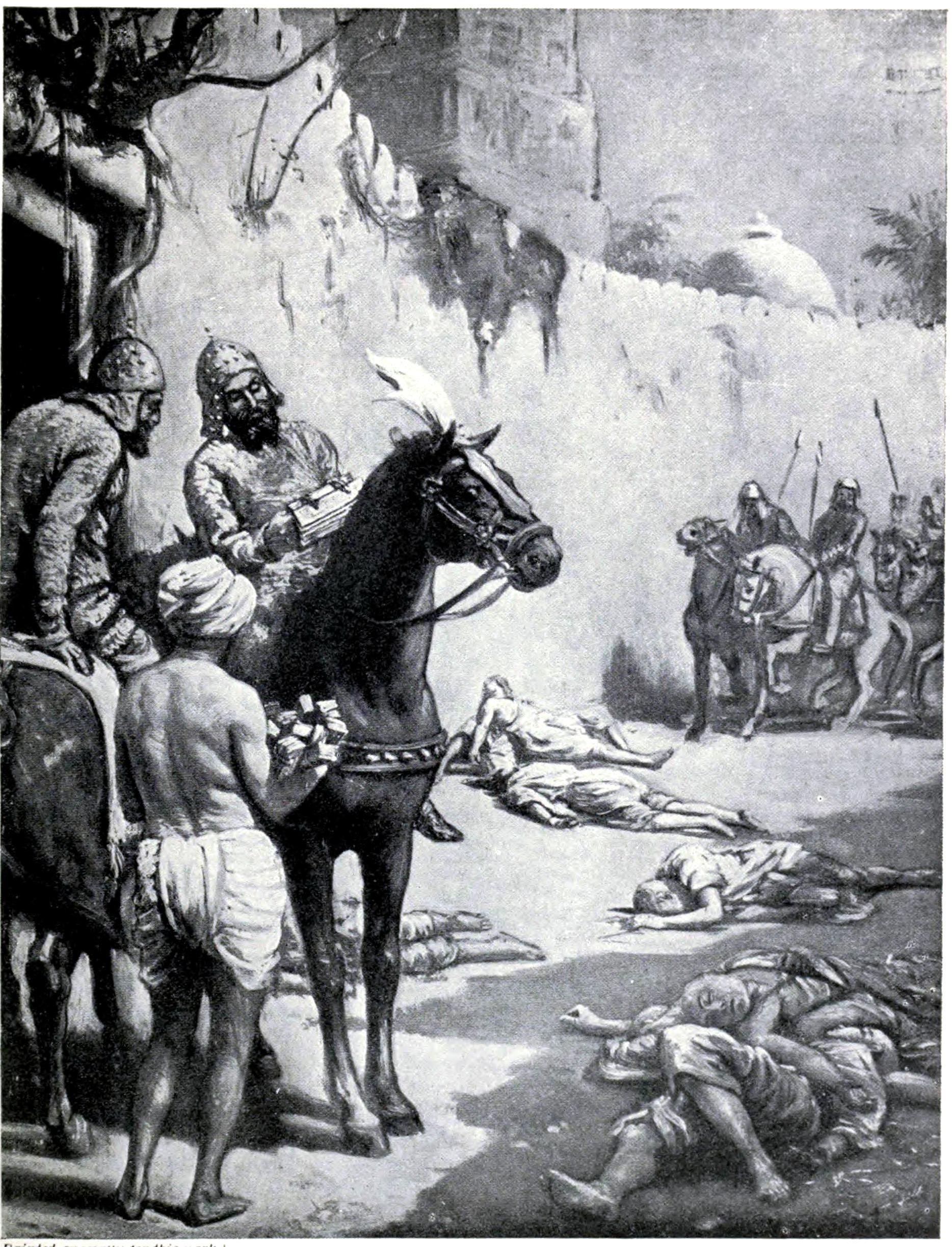
Imagine a group of horsemen riding into the campus of a world-famous university, mowing down students and professors until their bodies lie scattered everywhere. Imagine the same scene repeated at other universities, one after the other. And imagine all this in a time when there were no computers, no digital storage devices and no clouds to save the knowledge accumulated over generations. Mindless violence unleashed on the foremost universities of the time – Nalanda, Vikramshila and Odantapuri by Mohammad Bakhtyar Khilji and his men sent shock waves through Indic lands in the 13th century. The sacredness associated with institutions and persons of learning was violated in a manner never seen in India before.
The attack was chronicled by Minhaj-i-Siraj, principal historian of the Delhi Sultans in Tabaqat-i-Nasiri, who described the slaughter of thousands of “Brahmins” with shaven heads.
“There were a great number of books there; and, when all these books came under the observation of the Musalmans, they summoned a number of Hindus that they might give them information respecting the import of those books; but the whole of the Hindus had been killed.” (A.S.Altekar, 1944)
It is ironic that Bakhtyar Khilji hailed from a tribe in what is known as Afghanistan today, which practised Buddhism for centuries before being overrun by Ghaznavids and converting to Islam. In subsequent years, as Muslim rule spread and consolidated in different parts of India, many more universities were destroyed, such as Jagaddala, Somapura, Valabhi, Kashmir and others.  As the news spread, scholars abandoned their colleges even before the Muslim invaders appeared. In Banaras, one of India’s ancient centres of education, when several hundreds of temples were destroyed by Qutubuddin Aibak in the 12th century, many learned Brahmins who taught there fled to southern India along with their families (A.S.Altekar, 1944). Some of the scholars who escaped from Vikramshila and other universities, such as Sakya Sribhadra and Vibhutichandra made their way to Tibet, another hub of higher learning (Mookerjee, 1960). Records maintained by Buddhist monks at Tibet give accounts of the destruction of Indian universities. Translations of Sanskrit texts preserved in Tibet help to give some idea of the books that were found in the libraries of the great Indian universities (Sharma R. N., 2012).
Picture captioned “The end of Buddhist Monks, A.D. 1193” in Hutchinson’s Story of the Nations (Pg 169) shows Bakhtyar Khilji trying to make sense of the manuscripts that fell into his hands, Wikimedia Commons.
Had the rulers of India learned lessons from the earlier destruction of libraries in Alexandria, Cordoba, Persia and Ghazni (many of which contained texts that originated in India itself), and put their differences aside, perhaps India would boast of the world’s longest running universities today. More importantly, India would have retained its link with ancient works in Sanskrit, especially the ones on science and medicine. The destruction of key centres of higher education in India, including temples and the persecution of Hindus, Buddhists and other followers of Dharmic faiths during the centuries of Muslim domination affected the progress of Sanskrit scholarship considerably. The writing of new smritis and their revisions suffered a setback.
Historian A.L Srivastava has described the “325 years of Turko-Afghan rule” as a period of great suffering for Hindus, which were clearly not conducive to education, especially female education.
Not only were they deprived of their position as rulers, ministers, governors and commanders of troops, but were also treated contemptuously. The Turkish Sultans and their principal followers sought their brides from well-to-do Hindu families and compelled the proud chiefs to part with their daughters. In accordance with the Muslim law, the Hindu girls were first deprived of their religion, converted to Islam, and then married. (A.L.Srivastava, 1964)
The accounts of Brahmins fleeing to different parts of India to escape Muslim persecution are too many to be missed. Despite attempts by scholars to regroup in distant locations, and even to rebuild some of the destroyed universities, the old glory of Indic educational institutions could not be restored. The absence of science education that was noted by British chroniclers in a later era can be linked to the Muslim invasions of India. Sanskrit works of scientists and mathematicians of earlier periods began to be forgotten in their land of origin, even as their Arabic and Latin translations as well as plagiarised versions became the basis of science, mathematics and technology in Europe (See Part 2 of this article series).

Emphasis on Islamic Education

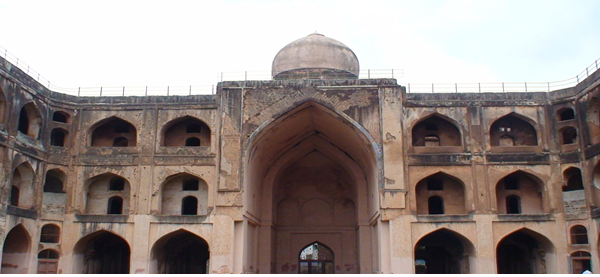
Madrasa built by Mahmud Gawan in Bidar, Karnataka. Photo: Syed Suhaib Mustafa, Wikimedia Commons
As the various Muslim dynasties got entrenched within India, education with the aim of imparting Islamic teachings became the norm. Muktabs and madrasas attached to mosques began to impart training in Islamic traditions. Says M.A. Khan in “Islamic Jihad: A Legacy of Forced Conversion, Imperialism and Slavery”:
Muslim rulers in India built only Islamic schools, namely muktabs and madrasas, often linked to mosques, solely for training Muslim students in their religion and other crafts for administrative and military duty, useful for the Muslim state. Learning Arabic and Persian language and memorizing the Quran, prophetic tradition and Islamic laws were the major subjects of study. Limited training was also given in agriculture, accountancy, astrology, astronomy, history, geography and mathematics, needed for running the state.
Muslim education was patronised by rulers from the Mamluk, Tughlaq and Lodhi dynasty as well as the Mughals and Bahmani Sultans. Delhi became one of the most important centres of Islamic learning (A.L.Srivastava, 1964). Other towns such as Jalandhar, Agra, Firozabad and provincial capitals also began to teach literature, philosophy and various humanities. The Islamic schools that used Persian as a medium of instruction were out of bounds for Hindu students. The lack of state support for education for Hindus led to a drastic decline in their higher education even though primary schools in villages continued to function wherever unjust taxation had not crippled finances completely. Many Hindus converted to Islam and learned Persian as a way of gaining respectable positions and to avoid the Jaziya tax imposed on non-Muslims. This was also a time when caste stratification became more rigid amongst Hindus in order to retain identities and preserve traditions.

Keeping Sanskrit and regional languages alive

Rich businessmen, Hindu Rajas and local communities kept the flame of learning alight for Hindus (Dwivedi, 1994). During the reign of Mughal emperor Akbar (16th century), Sanskrit received some amount of royal patronage since the ruler was interested in harmonising relationships between his Muslim and Hindu subjects. The first Sanskrit-Persian dictionary was compiled during Akbar’s reign (Mehta, 1984). Many works were produced in Sanskrit, Hindi-Urdu and regional languages such as Bengali and Marathi. It was the age of Tulsidas and Rahim. Akbar was keen for students to not solely restrict themselves to theology and classical literature. In Ain-i-Akbari, which chronicles the reign of Akbar, it is stated:
Everybody ought to read books on morals, arithmetic, the notation peculiar to arithmetic, agriculture, mensuration, geometry, astronomy, physiognomy (the art of discerning character from the features of the face), household matters, the rules of government, medicine, logic, Tabiyi (natural science), Riyazi (higher mathematics) and Ilahi (metaphysics and theology), and history; all of which may be gradually acquired.
In studying Sanskrit, students ought to learn the Vyakarana, Nyaya, Vedanta and Patanjali. No one should be allowed to neglect these things which the present time requires” (Dwivedi, 1994).
Akbar also encouraged the opening up of Madrasas for Hindu children so that Hindus and Muslims could study side by side. He introduced the study of Sanskrit in many madrasas. His imperial library in Agra housed as many as 24,000 manuscripts. The books had attractive bindings and were beautifully illustrated. The king loved to listen to readings of books on a variety of subjects. Jain monks produced a number of Sanskrit works during Akbar’s reign. (Mehta, 1984)
To some extent, the encouragement of literature in Sanskrit and regional languages continued under the reign of Jahangir and Shah Jahan. Sanskrit poets such as Panditaraja Jagannatha and Kavindra Acharya Saraswati were patronized by Shah Jahan (Sarma, 1994). A new language emerged from the amalgamation of Persian, Arabic and Hindustani, which was similar to today’s Urdu and Hindi.
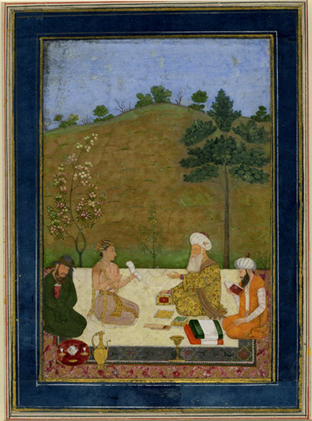
Dara Shikoh in the company of holy men. This painting is ascribed to Dal Chand. Courtesy Wikimedia Commons.
However, Aurangzeb reversed the inclusiveness that Akbar had ushered in during his reign. An Islamic fanatic, he persecuted Hindus and built new maktabs and madrasas on the ruins of demolished temples. (Riaz, 2008) On hearing that Brahmins at Thatta, Multan, Sindh and specially Varanasi were attracting Muslims to their discourses, he ordered all their temples and schools to be demolished (Mukhia, 2004). He killed his elder brother Dara Shikoh, the rightful heir to the throne, who was a Sanskrit scholar himself. With the help of pandits, Dara had translated Ramayana, Gita, Upanishads and Yogavasisthas to Persian; all of which constituted blasphemous acts in the eyes of his brother.
Dara’s Persian translation of Upanishads was translated to Latin in the beginning of the 19th century and created a renewed interest in the Upanishads among learned Europeans (Figueira, 1955). Had Dara become the emperor instead of Aurangzeb, India’s destiny could have been vastly different.

Neglect of sciences in the Mughal reign

The Mughals did not build on the leading-edge concepts presented by Hindu scholars of an earlier era to become the world leader in science and mathematics. While madrasas proliferated and students became adept in the finer details of the Quran and Hadiths in Muslim India, the western world was making advances in science and technology. Of course, these advances were considerably assisted by the Toledo school translations of Arabic works that were derived from India. (See Part 2 of this article). The Mughal kings missed the opportunity to ride the wave of technological discoveries in the west despite ruling over the richest land in the world. When Portuguese missionaries presented printed papers to Akbar, he was least interested in the potential of the printing press to transform education. His son Jahangir was similarly indifferent to a mechanical clock presented to him by the royal French delegation. (Riaz, 2008)
“The Mughal Empire has not produced a single worthwhile text on crafts or agriculture, how many volumes of poetry or histories it might have to its credit,” writes Irfan Habib (Habib, 2008). Apart from printing press and clocks, Mughal rulers were aware of nautical instruments, telescopes, pumps, various mechanical gadgets and wheelbarrows. Yet, these did not excite any desire for indigenous adaptation (Qaisar, 1982). The marvels of Mughal architecture were achieved without the aid of wheelbarrows (Kumar & Desai, 1982).

Arrival of the colonialists

Meanwhile, the Europeans who had been coming to India via the sea route from the 15th century onwards were battling amongst themselves for cornering the trade with India. The British East India Company emerged victorious after pushing the Portuguese, French and Dutch to the periphery and began spreading its tentacles within India. At first, the British did not bother themselves with education of the “natives” and focused on playing politics with different rulers and enriching themselves. Over time, they realised that “their dominion in India could not last long unless education – especially western – was diffused among the inhabitants of the land” (Basu, 1922).
A Mohammedan and a Sanskrit college were set up in Kolkata and Banaras respectively in the late 18th century “to provide a regular supply of qualified Hindu and Mohammedan law officers for the judicial administration” (Trevelyan, 1838). The British did not have any noble motives of education of the masses when they set up institutes of learning. These were the same people who imposed serious punishment on black slaves in America and passed laws to the effect that “assemblage of negroes for the purpose of instruction in reading or writing shall be an unlawful assembly” (Basu, 1922).

Anglicists versus Orientalists and their disdain for Indian knowledge

Many of us are familiar with Macaulay’s memorandum or “minute” on Indian Education, which was circulated by him prior to the passing of the English Education Act of 1835. That act gave effect to Governor-General William Bentinck’s decision of reallocating of funds towards a western curriculum with English as the language of instruction.
Thomas Babington Macaulay’s minute is a classic that needs to be read by every “educated” Indian:
“We must at present do our best to form a class who may be interpreters between us and the millions whom we govern – a class of persons Indian in blood and colour, but English in tastes, in opinions, in morals and in intellect. To that class we may leave it to refine the vernacular dialects of the country, to enrich those dialects with terms of science borrowed from the Western nomenclature, and to render them by degrees fit vehicles for conveying knowledge to the great mass of the population.”
Macaulay’s minute and the English Education Act came after a 15-year debate between the older faction of Orientalists and the later Anglicists. The Orientalists argued that government funds should be used to support colleges for the teaching of Arabic and Sanskrit, to pay stipends to the students at these colleges, and to translate works into Arabic and Sanskrit. The Anglicists on the other hand, advocated that these government funds should be spent on teaching English, with no stipends or translations at all. (Clive, 1971)
Most Orientalists and Anglicists had one thing in common – their belief in the “innate inferiority of the Indian culture” and the need to educate the elites (Clive, 1971). They only differed on how best to “improve” the minds of Indians, how to “correct” their beliefs and make them more useful as subjects of the British Empire.
Orientalists such as John Tytler believed in gradual reform via teaching in Arabic and Sanskrit so that the British could understand Indian culture and then prove it wrong. This method would lead to Indians themselves “correcting their countrymen”. (Clive, 1971)
Charles Trevelyan, brother-in-law of Macaulay and an avowed Anglicist, said before the Select Committee of the House of Lords on the Government of Indian Territories that both “Hindoos and Mahomedans” regarded the British as “usurping foreigners” who had “taken the country from them” and excluded them from “the avenues to wealth and distinction”. He argued that European learning “would give an entirely new turn to the native mind”. The natives would cease to “strive after independence in the native model” and would not regard the British as “enemies and usurpers”, but as “friends and patrons, and powerful beneficent persons”. (Basu, 1922)
Trevelyan’s arguments against Sanskrit and Arabic as a means of instruction sound Kautilyan in strategy. Arabic literature would keep reminding Muslims that the British were “infidel usurpers” while Sanskrit texts would inform Hindus that their foreign rulers were “unclean beasts”. He pointed out that already in the army, there was a clear distinction between the English officers and the native sepoys. Not “one native out of 500” educated in Arabic in a seminary would be interested in enlisting in the army. Therefore, it was important to educate “sepoys” in English at the elementary level (Trevelyan, 1838). For the elites, English literature would do the trick. Familiarly acquainted with literature, the Indian youth would speak of great Englishmen with the “same enthusiasm” as the British themselves. They would reject the teachings of Brahmin priests. “The natives will not rise against us because we shall stoop to raise them,” he explained.  Also, he noted that those educated in English would “cling” to the British rule because they would have everything to fear from a native government, which could mark them out for persecution. This last surmise of Trevelyan’s was clearly wrong, as the subsequent freedom movement of India proved.
Many Anglicists emphasised on the convenience attached to having English-speaking natives. Given that a large number of British officers were constantly being deputed in India, it was troublesome for them to understand the various languages and dialects of the natives. Also, it was a costly and time-consuming affair to translate various English books into native languages. In other words, the interests of the people of the land became subservient to convenience.
In addition to the Anglicists, there were the Vernacularists, who rejected Sanskrit and Persian in favour of regional languages. They championed the teaching of European knowledge in “vernacular” languages. The term “vernacular” itself has a derogatory meaning in the sense of being a language that is less cultured or refined.

Christian evangelism as a driver of education

It must be noted that spreading Christianity was a desirable goal for most Anglicists, Orientalists as well as Vernacularists. Dr Alexander Duff, an Anglicist, who opened a popular school in Calcutta was against “heathen” institutions. Macaulay himself wrote in a letter to his father, “No Hindoo who has received an English education ever remains sincerely attached to his religion.” He expressed his “firm belief” that if his plans of education were followed up, “there will not be a single idolator amongst the respectable classes in Bengal thirty years hence.” (Basu, 1922)
JC Marshman who made a sincere plea for retaining “Bengalee” as a medium of instruction gave the example of Serampore missionaries whose “labours” in “civilization and evangelization of the province of Bengal” had led to the establishing of 40 printing presses in a few decades and selling of 30,000 books in just one year. (Basu, 1922)
Many Christian missionaries learned regional languages such as Tamil and Kannada, published dictionaries in them and translated the Bible for evangelization activities. They appropriated several aspects of Hinduism into Christianity in order to make it more palatable to the locals and wean them away from traditional Sanatana Dharma.
English language struck roots in the land as the English Education Act began to take effect and the missionary schools that mushroomed across the country made English the “first language”.

Many Indians were Anglicists

An important argument made by Anglicists in favour of standardising English-medium education was that the Indian natives themselves were eager to learn English. “A taste for English has been widely disseminated,” said Trevelyan. He happily noted that a “loud call” arose from the natives themselves to be instructed in English. Schools teaching in English were extremely popular and English books were selling far more rapidly than books in Sanskrit and Arabic (Trevelyan, 1838). This is not surprising, since a good knowledge of English opened opportunities for government jobs all over the country. Besides, the vacuum in science and disconnect with Sanskrit works on science and mathematics caused by the Muslim rule made many Indians feel backward in comparison to the Europeans.
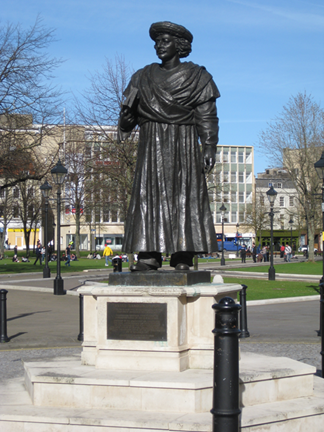
Raja Rammohan Roy's statue in Bristol
Raja Rammohan Roy’s statue in Bristol
Raja Rammohan Roy is one of the most notable Indian Anglicists, who petitioned for the teaching of the “arts and sciences of modern Europe” and argued against establishing a new Sanskrit college in Calcutta in his letter to Lord Amherst. “The Sanskrit language, so difficult that almost a lifetime is necessary for its acquisition, is well known to have been for ages a lamentable check on the diffusion of knowledge; and the learning concealed under this almost impervious veil is far from sufficient to reward the labour of acquiring it,” he wrote. A new Sanskrit college, which taught the same things that were taught “two thousand years ago” would not help since ‘no improvement can be expected from inducing young men to consume a dozen of years of the most valuable period of their lives in acquiring the niceties of Byakaran or Sanskrit grammar,” he felt. Roy believed that giving allowances to the teachers engaged in teaching Sanskrit in different parts of India would be enough to keep the language alive and no new Sanskrit colleges were necessary. He was instrumental in the establishment of the Hindoo College in 1817 for imparting secular and scientific education, which later came to be known as the famous Presidency College of Kolkata. The alumni of the institute include outstanding personalities such as Bankim Chandra Chatterjee, Satyendranath Bose and Meghnad Saha.

Dharampal’s revelations of astounding data on India’s popular schooling system

When India was embroiled in the education debate, England was itself languishing in illiteracy. A minuscule fraction of the children in England went to school, and the only book most literate people had read was the Bible. In the 1960s, Dharampal, a Gandhian thinker came across archival material of extreme significance in London. He discovered documents related to a series of surveys commissioned by the British government in the 19th century to assess the level of indigenous education in India. This set him on the path of pioneering research, which brought up startling data. He discovered Thomas Munro’s statement that almost every village in India had a pathshala (school). There were 100,000 village schools reported in Bengal and Bihar alone in the 1830s. Reading, writing, arithmetic, epics and more were being taught. William Adams, one of the surveyors has written that he could not recollect studying in his village school in Scotland anything that had more “direct bearing” upon daily life than what was taught in the “humbler village schools of Bengal”. (Dharampal, 2000)
From different parts of India came reports of dedicated teachers, superior methods of teaching and high school attendance. But what simply challenged every stereotype was that in a large number of schools, “Soodras” were in majority while the Brahmins and “Vysees” were in minority. In Tamil-speaking areas, the Shudras ranged from 70% in Salem and Tinnevelly to over 84% in South Arcot. In Malayalam-speaking Malabar, Brahmin students constituted only 20% of schools, while Shudras were 54% and Muslims were 27%. The same trend was reported in Kannada-speaking Bellary and Oriya-speaking Ganjam. Only in the Telegu-speaking districts, the dwija castes formed the majority of students. Some collectors who furnished data spoke about poor Brahmins who taught children with no expectation of compensation. Girls were mostly home-schooled. However, in the Malabar district as well as “Jeypoor Zamindari of Vizagapatam district”, the percentage of girls was close to 30%, a very high number.  (Dharampal, 2000)
It must be remembered that schooling was not the only way of transmitting basic education. Artisans, craftsmen and agriculturalists taught their skills to apprentices via a separate system of education.
A.D.Campbell, the collector for Bellary applauded the “economical” teaching methods in Indian schools and the system of “more advanced scholars” teaching the “less advanced” thereby confirming their own knowledge. He mentioned that this method “well deserved the imitation it had received in England”. He was referring to the “Madras Method” of teaching, which was introduced by Reverend Andrew Bell in England. Dr Bell had been impressed by little children in Madras writing with their fingers on sand, which “after the fashion of such schools had been strewn before them for that purpose”. He saw a system of children learning from peers. After Dr Bell published his paper on Madras Method, he was in great demand to introduce this in British schools. By 1821, 300,000 children were reportedly being educated under Dr Bell’s principles and his ideas were adopted in Europe, West Indies and even Bogota, Colombia. (Tooley, 2009)

The Beautiful Ecosystem is uprooted

As the British rule progressed in India, villages got increasingly impoverished. For example, when the British with the Nawab of Arcot attacked Thanjavur in 1771 and imposed taxes as high as 59% of gross produce, they created mass poverty overnight! The entire British administrative apparatus was geared towards fleecing the citizens and even the designations of officers such as “District Collectors” indicated that the only aim of the government was to collect taxes. One collector of Bellary was so moved by the plight of the people that he wrote a letter to the authorities that the degeneration of education was attributable to the “transfer of capital of the country from the native government…to the Europeans, restricting it by law from employing it even temporarily in India and daily draining it from the land.” Further, he wrote, “The means of the manufacturing classes have been greatly diminished by the introduction of our own European manufactures.”(Dharampal, 2000)
The British educational policies also sounded the death knell for regional languages as the rush for English-medium education intensified. With every subject being taught in English and mother-tongues being relegated to “second language” the quality of literature in regional languages began sinking. Illiteracy and low self-confidence began to be associated with absence of English proficiency. M.K.Gandhi said in 1931 that the British had left India more illiterate than it was a hundred years ago. Today, India has the largest number of illiterate in the world.
Disturbingly, India’s self-gaze is still through alien eyes. The past heritage lies buried in regional and Sanskrit literature, awaiting illumination. When India became independent from the British in 1947, there was a fresh opportunity to write a new chapter of decolonization.
India is still waiting.
The author would like to acknowledge the critical inputs of the members of Indian History Awareness and Research (IHAR). She would also like to express gratitude to Rare Book Society of India and Nikhil Dureja for generously sharing books that provided key references for writing this article.
Works Cited
A.L.Srivastava. (1964). The Sultanate of Delhi 711 to 1526 AD. Shiva Lal Agarwala.
A.S.Altekar. (1944). Education in Ancient India. Nand Kishore and Bros.
Apte, D. Universities in Ancient India.
Basu, B. D. (1922). History of Education in India Under the Rule of the East India Company. The Modern Review Office.
Bose, M. (1990). A Social and Cultural History of Ancient India. Concept Publishing Company.
Clive, J. (1971). The debate on Indian education: Anglicists, Orientalists and the ideology of Empire.
Dharampal. (2000). The Beautiful Tree. Other India Press.
Dwivedi, B. L. (1994). Evolution of Educational Thought in India. Nothern Book Centre.
Figueira, D. M. (1955). Translating the Orient- The Reception of Sakuntala in Nineteenth Century Europe. State University of New York Press.
Habib, I. (2008). Technology in Medieval India. Tulika Books.
Kumar, D., & Desai, M. (1982). The Cambridge Economic History of India Vol 2. Cambridge University Press.
Mehta, J. (1984). Advanced Study in the History of Medieval India. Sterling Publishers Pvt Ltd.
Mookerjee, R. K. (1960). Ancient Indian Education – Brahminical and Buddhist. Motilal Banarsidass.
Mukhia, H. (2004). The Mughals of India. Blackwell Publishing.
Qaisar, A. (1982). Indian Responses to European Technology and Culture. Oxford Universoty Press.
Riaz, A. (2008). Faithful Education: Madrassahs in South Asia. Rutgers University Press.
Sarma, N. (1994). Panditaraja Jagannatha – The Renowned Sanskrit Poet of Medieval India. Mittal Publications.
Sharma, R. N. (2000). History of Education in India. Atlantic Publishers.
Sharma, R. N. (2012). Libraries in the early 21st century, volume 2: An international perspective. De Gruyter Saur.
Tooley, J. (2009). The Beautiful Tree – A personal journey into how the world’s poorest people are educating themselves. Cato Institute.
Trevelyan, C. E. (1838). On the Education of the People of India.
Feature Image Credit: Erik Törner
Disclaimer: The facts and opinions expressed within this article are the personal opinions of the author. IndiaFacts does not assume any responsibility or liability for the accuracy, completeness, suitability, or validity of any information in this article.
Sahana Singh is a writer/editor who specializes in environmental issues, current affairs and Indian history. She is a member of Indian History Awareness and Research (IHAR), a think tank headquartered in Houston.